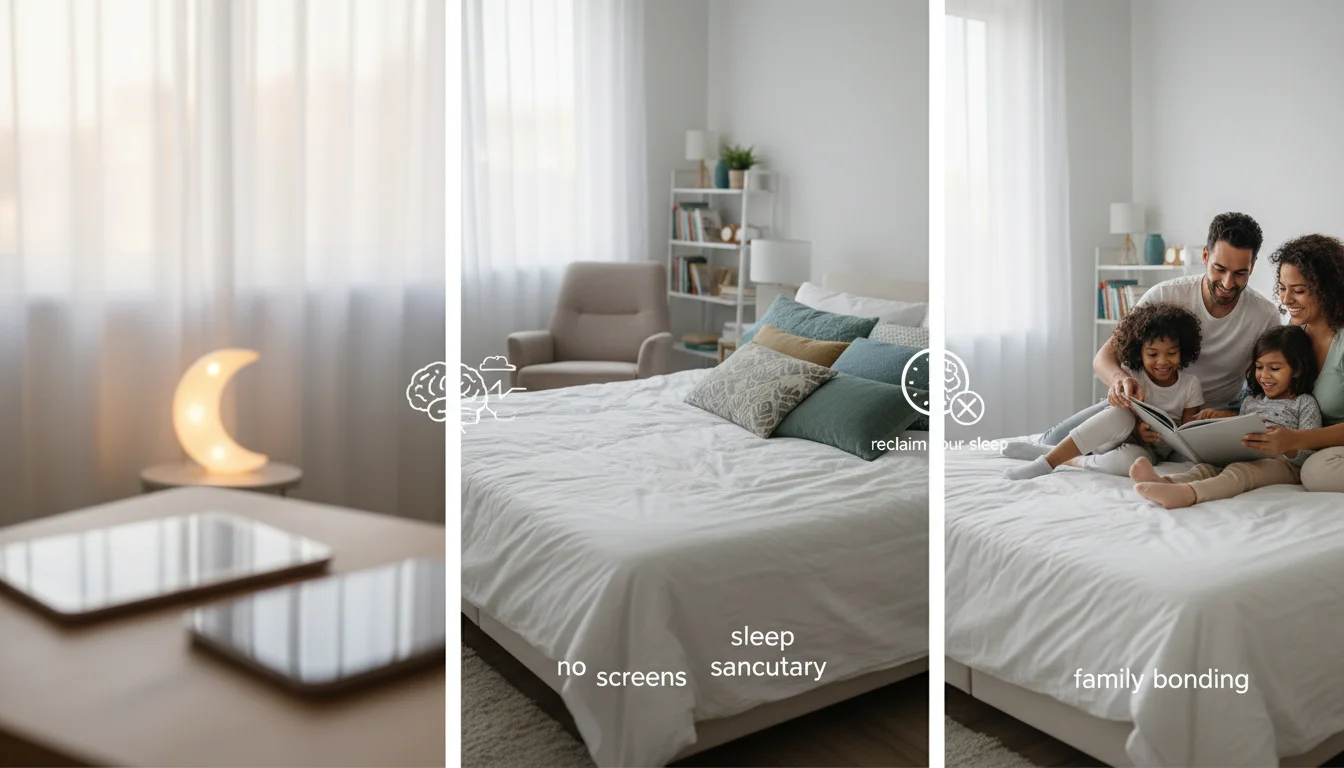
Your Phone Isn’t Just on Your Nightstand—It’s in Your Nervous System. Let’s Reclaim Your Sleep.
If you’re reading this, there’s a good chance you’re tired. Not just the “need another coffee” tired, but a deep, persistent fatigue that feels wired into your very being. You know the advice: get more sleep. But in a world where our primary companions are glowing rectangles, “just go to bed earlier” feels as realistic as building a rocket in your garage. The guilt is real—you want to model healthy behavior for your kids, you want to feel rested for your job, but the pull of the screen is a powerful, 24/7 current.
As a behavioral psychologist, I want you to hear this first: your struggle is not a personal failing. It is a predictable, neurological response to an environment engineered to capture and hold your attention. The battle for your sleep is a battle for your brain’s most basic rhythms. Today, we’re moving beyond generic “sleep hygiene tips” to a psychologically-grounded framework I call The Sanctuary Protocol. This isn’t about shaming your tech use; it’s about strategically designing your physical and digital environment so that sleep becomes the default, not the fight.
The Neurological Hijack: Why Blue Light is the Least of Your Worries
We’ve all heard about blue light effects. Yes, the short-wavelength light from screens can suppress melatonin, the hormone that cues sleepiness. But fixating on blue light blockers alone is like putting a band-aid on a broken leg. The real disruption is far more profound.
Every ping, scroll, and notification triggers micro-doses of dopamine and cortisol. Dopamine keeps you seeking—“just one more video.” Cortisol, your primary stress hormone, activates your sympathetic nervous system—the “fight or flight” response. When you check a work email or scroll through a stressful news feed at 10 PM, you’re not just seeing light; you’re telling your primal brain to prepare for threat or opportunity. You are chemically shifting your body into a state of alertness, directly opposing the physiological descent into sleep.
Furthermore, the content itself creates what I term cognitive residue. The unresolved argument on social media, the planning for tomorrow’s meeting, the viral tragedy on the news—these narratives don’t disappear when you lock the screen. They continue to process in your prefrontal cortex, inhibiting the mind’s ability to quiet down. Your bedroom, with a device in it, becomes a chamber of cognitive and emotional arousal.
The Sanctuary Protocol: A 3-Zone Framework for a Tech-Free Bedroom
Creating a true sanctuary requires more than good intentions. It requires a behavioral system. This protocol establishes clear, physical boundaries that automate healthy decisions.
| Zone | Physical Boundary | Behavioral Rule | Psychological Purpose |
|---|---|---|---|
| Zone 1: The Charging Sanctuary | A shelf, drawer, or charging station outside the bedroom (e.g., kitchen, hallway). | All family devices (phones, tablets, smartwatches) dock here 60 minutes before target bedtime. | Physically separates sleep space from arousal triggers. Eliminates the temptation of the “midnight reach.” |
| Zone 2: The Transition Buffer | The last 30-60 minutes inside the bedroom before lights out. | Strictly for non-digital, low-arousal activities: reading a physical book, light stretching, conversation, gratitude journaling. | Allows cortisol levels to drop and cognitive residue to clear. Initiates the neurobiological shift to rest. |
| Zone 3: The Sleep Core | The bed itself. | For sleep and intimacy only. No phones, no laptops, no “just watching one episode.” | Reinforces the powerful classical conditioning between bed and sleep, strengthening your brain’s sleep drive. |
Implementing this as a family is powerful. For the Concerned Parent, it models intentionality. For the Identity-Seeking Teen, it provides a clear, non-negotiable structure that actually reduces the anxiety of constant availability. For the Burned-Out Professional, it creates a sacred boundary that the workday cannot cross.
Beyond the Bedroom: Daytime Habits That Build Sleep Pressure
Sleep hygiene doesn’t start at night. It’s a all-day practice that builds what sleep scientists call “sleep pressure.” Think of it like preparing a garden; nighttime is the harvest, but the planting happens in the sunlight.
- Master Your Morning Light: Within 30 minutes of waking, get 10-15 minutes of natural sunlight on your face (without sunglasses). This isn’t just pleasant; it’s a critical signal to your suprachiasmatic nucleus—your brain’s master clock—that the day has begun. This single action helps regulate your cortisol curve and sets a clear countdown for melatonin release roughly 14 hours later. It’s the most powerful, free tool for circadian rhythm alignment.
- Schedule Your Digital “Caffeine”: Just as you wouldn’t drink espresso after dinner, be mindful of your digital caffeine—high-stimulus content like action movies, intense gaming, or doomscrolling news. Establish a household “digital decaf” time 2 hours before the Zone 1 device dock. This is a great time for analog games, podcasts, or quiet hobbies.
- Curate Your Evening “Diet”: Your media consumption is a diet for your mind. In the evening, shift from an “algorithmic feed” to a curated library. Choose a specific movie, a pre-downloaded audiobook, or a playlist. This puts you in control of the narrative and emotional input, preventing the unpredictable, often-arousing content that autoplay serves up.
The Family Connection Audit: Trading Screen Time for Sleep Time Rituals
We cannot simply remove technology without replacing the connection or relaxation it (often falsely) provides. This is where we reclaim human ritual. Once a week, conduct a brief Family Connection Audit. Ask: “What did we do this week that helped us feel connected without a screen?”
Use the answers to build your family’s unique pre-sleep ritual toolkit. Here are a few evidence-backed ideas:
- The 3-Minute Download: For teens and adults, a brief, structured chat to empty the “cognitive residue.” Each person shares: One thing from today I’m leaving here (a worry), and one thing I’m taking to bed (a gratitude). This practice, based on therapeutic techniques, provides closure.
- Progressive Muscle Relaxation for All Ages: A simple, guided tension-and-release exercise for the body. For younger kids, call it “squeezing lemons” with your hands or “turtle hiding” by pulling shoulders up to ears and then releasing. This directly counters the physical tension of screen-based passivity.
- The Analog Anchor: Invest in a traditional alarm clock. This single purchase is the most tangible commitment to a tech-free bedroom. It removes the final, flimsy excuse of “but my phone is my alarm.”
Addressing the Real-World Objections: A Clinician’s Perspective
I know the pushback. Let’s apply empathetic problem-solving.
Objection: “I use my phone for white noise/meditation/sleep tracking.”
Solution: If a device function is non-negotiable, apply extreme hygiene. Enable Do Not Disturb (allowing only alarms), set the screen to grayscale, and use a dedicated app that locks you into that single function. Better yet, invest in standalone devices like a white noise machine or a basic fitness tracker that doesn’t have a screen. The goal is to remove the interactive screen.
Objection: “My teen will never agree to this.”
Solution: Frame it collaboratively, not punitively. Present the neuroscience. Say, “I’m learning how our devices are designed to keep us hooked, and it’s interfering with our sleep and mood. Let’s experiment with a family sanctuary for one week and see how we feel.” Use the American Psychological Association’s health advisory on social media as a neutral authority. The focus is on collective wellbeing, not control.
Objection: “My work requires me to be on call.”
Solution: Negotiate a boundary. Can you use a dedicated work phone that stays in a bag by the front door after a certain hour? Can you set a specific, rare ringtone for true emergencies that’s allowed to bypass Do Not Disturb, while mutting all other notifications? The principle is to create a permeable boundary, not a non-existent one. You are designing for the 95% of nights that aren’t emergencies, protecting your sleep to handle the 5% when they occur.
FAQ: Your Sleep Hygiene Questions, Answered
Q: Is reading on a Kindle or e-ink reader just as bad as a phone?
A: This is a nuanced but important distinction. Dedicated e-ink readers (like a basic Kindle without a built-in light or web browser) are a significant step better. They lack the LED backlight, refresh rate, and interactive notifications that cause high neurological arousal. If you must read digitally, this is the preferable tool. However, a backlit tablet in “reading mode” is still an interactive screen and falls under the Sanctuary Protocol rules.
Q: What about “Night Shift” or dark mode? Doesn’t that fix the blue light problem?
A: These features are a minor improvement, but they are a technological fig leaf over a behavioral canyon. While they reduce some blue light, they do nothing to address the dopamine-driven scrolling, the cortisol spike from alerts, or the cognitive residue from engaging content. The primary goal is disengagement, not just color adjustment.
Q: How long will it take to see a difference in my sleep if I create a tech-free bedroom?
A: Behavioral research suggests most people notice improvements in sleep onset (falling asleep faster) and subjective sleep quality within 3-7 nights. However, fully resetting your circadian rhythm and overcoming years of conditioned arousal can take 2-3 weeks of consistent practice. Be patient and track how you feel, not just how many hours you clock. For more on circadian science, the National Sleep Foundation is an excellent resource.
Q: I live in a studio apartment. How can I possibly create these zones?
A: Use symbolic boundaries. Your “Charging Sanctuary” can be a specific box or shelf across the room from your bed. Use a room divider or a piece of furniture to visually separate your sleep area. The key is ritual: the act of physically walking the device to its “dock” and changing your environment (e.g., lowering lights, changing clothes) signals the transition to your brain, even in one room.
Remember, this isn’t about achieving perfection. It’s about progressive intention. Start tonight. Perhaps just charge your phone outside the room. Notice the strange silence, the slight anxiety, and then the profound relief. You are not powering down your life; you are powering up the most restorative, human system you possess. You are building a sanctuary, one boundary at a time.