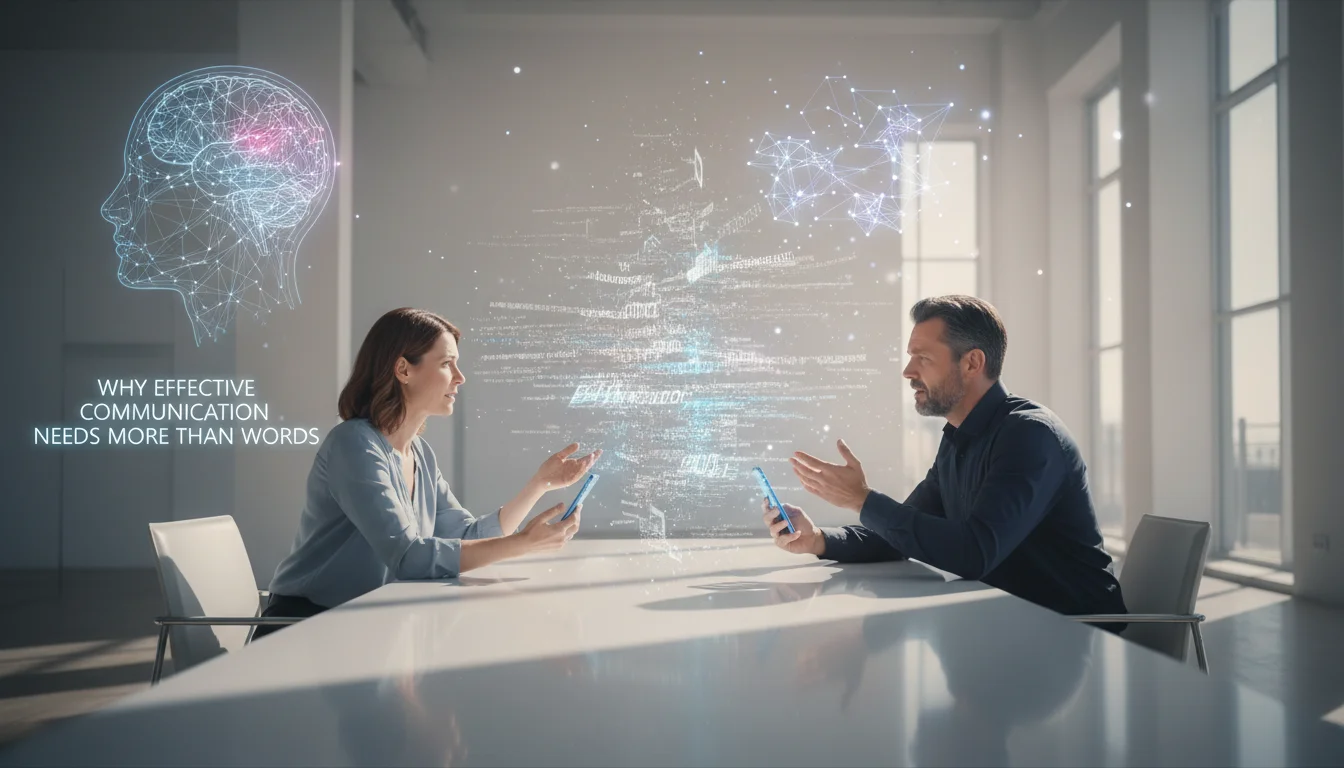
Your Phone is a Terrible Interpreter: Why Effective Communication Needs More Than Words
If you’re feeling a persistent, low-grade static in your family relationships—a sense of being heard but not understood, of connecting but not truly *connecting*—you’re not imagining it. As a behavioral psychologist, I see this daily. We are, paradoxically, the most connected and least communicative generation in history. We have mastered the art of the quick reply, the perfect emoji sequence, and the witty comment, but we’ve let atrophy the foundational human skills of reading a room, listening with our full attention, and interpreting the unspoken symphony of body language.
The pain point isn’t just miscommunication. It’s the social media anxiety that bleeds offline: the fear that a paused response means anger, the over-analysis of a period where none is needed, the constant performance of okay-ness. We’re trying to decode human complexity through a 6-inch screen, and it’s making us profoundly anxious and lonely.
Today, we’re moving beyond emojis. We’re building a blueprint for effective communication that treats your real-life interactions with the same intentionality you might give to curating a playlist. This isn’t about becoming a mind reader; it’s about relearning the language we were all born speaking—the language of presence.
The Digital Disconnect: How Screens Train Us to Misread Cues
To understand where we need to go, we must diagnose the problem. Our digital environments are essentially cue-poor settings. They strip away tone (until we add it back with punctuation!!!), facial expression, posture, proximity, and eye contact. Our brains, desperate for social data, fill in the gaps—often with worst-case scenarios born from our own insecurities. This is a prime driver of that pervasive social media anxiety.
The Algorithmic Echo Chamber: Online, we engage with curated personas and text. We lose the vital practice of navigating subtle, conflicting signals—like the friend who says “I’m fine” with a tense jaw and crossed arms. Offline, these mixed signals are crucial for depth. Online, ambiguity often leads to anxiety.
The Notification Mindset: Our devices train us for sporadic, interrupt-driven engagement. True effective communication, especially the kind that builds trust and reduces anxiety, requires sustained, undivided attention. We’ve become skilled at switching tasks, but we’ve impoverished our capacity for deep focus on another person.
The first step is recognizing that the tools we use for so much of our interaction are fundamentally limited. They are great for logistics, sharing, and broad connection, but terrible for nuance, repair, and deep emotional understanding. That must happen in the analog world.
The Two-Pillar Framework for Analog Communication
Rebuilding your communication muscles requires a structured approach. Think of this as a weekly fitness plan for your relational health. It rests on two core pillars: Receptive Decoding (reading body language) and Active Construction (deep listening).
Pillar 1: Receptive Decoding – The Body Language Blueprint
Body language isn’t a secret code. It’s the physical manifestation of our nervous system. We’re not looking for “one tell” for lying or interest; we’re looking for clusters and congruence. Does the spoken word match the physical presentation?
Here is a practical framework I call the Triangulation of Cues. Don’t isolate one signal; look for at least two from a cluster to form a hypothesis.
| Channel | Common Signals | Potential Meaning (Always Context-Dependent) | Digital Equivalent (The Limitation) |
|---|---|---|---|
| Eyes & Face | Pupil dilation, genuine “crow’s feet” smiles vs. tight lip smiles, eyebrow raises, prolonged eye contact or consistent avoidance. | Engagement, interest, delight, skepticism, anxiety, or discomfort. | Emojis, which are conscious choices, not subconscious leaks. A 😊 tells you nothing about genuine joy. |
| Posture & Proximity | Leaning in, open torso (uncrossed arms), mirroring your posture, creating or reducing physical distance. | Openness, agreement, rapport, desire to connect, or defensiveness, withdrawal. | None. A text gives no sense of physical presence or orientation. |
| Gestures & Fidgets | Illustrative hand movements, still hands vs. nail-biting, leg bouncing, touching the face or neck. | Enthusiasm, nervous energy, self-soothing, processing stress, or distraction. | GIFs or reaction videos, which are again performative, not reflexive. |
| Vocal Tone & Pace | Changes in pitch, speed, volume, pauses, sighs, laughter. | Sarcasm, sincerity, excitement, uncertainty, overwhelm. | Voice notes get closer, but still miss the visual cluster. Punctuation is a poor substitute for vocal nuance. |
Practical Exercise: The Commercial Break Study. Tonight, watch a TV drama with your family, but on the first commercial break, hit mute. Based solely on the body language and facial expressions of the characters, have each person guess what the conflict or emotion is. You’ll be stunned at how much you can accurately decode. This trains your observational muscles in a low-stakes environment.
Pillar 2: Active Construction – The Architecture of Deep Listening
If Pillar 1 is about input, Pillar 2 is about your output as a listener. Active listening is not passive waiting for your turn to talk. It is the active, verbal, and non-verbal construction of a space where the other person feels psychologically safe to be fully heard. This is the single most powerful antidote to the social media anxiety rooted in feeling invisible.
Forget the generic “listen more” advice. Implement this LISTEN protocol:
- L: Lock your device. Physically. This isn’t just putting it down; it’s placing it out of sight and out of reach. Your body orientation is the first signal of your attention.
- I: Inquire with “What” and “How.” Move beyond yes/no questions. Instead of “Was your day good?” try “What shaped your day today?” This invites narrative.
- S: Summarize to solidify. Periodically reflect back. “So what I’m hearing is that the project was frustrating not because of the work, but because of the unclear feedback.” This confirms understanding and validates their experience.
- T: Tolerate the pause. Resist the urge to fill silence. A pause is often where the real feeling emerges. Count to five in your head after they seem to finish a thought.
- E: Echo the emotion. Name the feeling you perceive. “That sounds incredibly disappointing,” or “You seem really excited about that!” This builds emotional vocabulary and connection.
- N: Next-step curiosity. Ask about forward movement. “What do you think your next step might be?” This positions you as a collaborator, not just a spectator.
The Family Connection Audit: A Weekly Ritual
Theory is nothing without practice. I prescribe this 20-minute weekly ritual for families and couples. It’s designed to be a device-free zone of intentional communication practice.
- Environment Setup (5 mins): Choose a consistent time and place (Sunday evening kitchen table, Thursday after-dinner couch). All devices go into a basket in another room. Start with a simple check-in prompt like “High, Low, and a Hope” for the week.
- Focused Share (10 mins): One person is the “sharer” for the round. The others practice the LISTEN protocol. The goal is not problem-solving, but pure understanding. The sharer can talk about anything—a school project, a work stress, a hobby interest.
- Reflection (5 mins): Briefly discuss the process. “How did it feel to be fully listened to?” “What was hard about not jumping in with advice?” This meta-conversation builds your collective communication IQ.
This ritual does more than share information; it rebuilds the neural pathways for attention and empathy that our digital lives constantly erode. It’s a direct counterweight to the fragmented, reactive communication style of group chats and social media threads.
When Digital Communication is Unavoidable: The Intention Filter
We live in the real world. Much of our daily logistics will happen over text. The key is to apply a filter of intention.
- For Complex or Emotional Topics: Use the “Digital Doorbell” rule. Text to ask: “Can I call you about X? Need to talk through something.” This respects their time and mental space, and moves the nuanced conversation to a richer channel.
- To Mitigate Anxiety: Add brief context to ambiguous messages. Instead of just “We need to talk,” try “We need to talk about the vacation plans—I have some fun ideas to run by you!” This short-circuits the catastrophic interpretation machine.
- Practice Vocal Appreciation: Send a spontaneous voice note just to say you’re thinking of someone. The human voice carries a warmth and presence that text cannot, bridging the gap slightly.
FAQ: Navigating Common Communication Hurdles
Q: My teen just grunts and looks at their phone. How do I even start?
A: Start side-by-side, not face-to-face. Invite them for a drive or to help with a task (walking the dog, making food). The reduced eye contact can feel less confrontational. Use open-ended questions about their interests, not their performance. “What’s the most interesting thing you saw online today?” can open more doors than “How was school?”
Q: I have social anxiety. Focusing on body language makes me more self-conscious.
A: This is common. Shift your focus outward. When anxious, we become hyper-focused on our own internal sensations. Deliberately practice observing one external detail in your environment or about the person you’re with (e.g., “What color are their eyes?” “What’s on their bookshelf?”). This grounds you and makes observation a curious distraction, not a performance.
Q: Are video calls a good substitute for in-person communication?
A: They are a powerful supplement, but not a substitute. They restore facial cues and tone, which is a massive upgrade from text. However, they often miss full-body posture and the shared physical space. Be intentional: use a stable connection, look at the camera (not your own face), and minimize multitasking to make them as rich as possible. For critical conversations, they are far superior to text.
The path to effective communication in the digital age isn’t about abandoning our devices. It’s about reclaiming our biological birthright as nuanced, empathetic communicators. It’s about recognizing that the anxiety we feel in our relationships is often a signal—a signal that we are starving for the rich, multi-sensory data of a real, present connection. Start small. Practice the Commercial Break Study. Implement one step of the LISTEN protocol. Your relationships, and your own sense of calm, will thank you for building this essential human infrastructure.
For further reading on the science of nonverbal communication, I recommend the work of researchers like Psychology Today’s Nonverbal Communication archive. To understand the impact of technology on attention, Harvard’s Usable Knowledge on digital distraction provides excellent insights.