
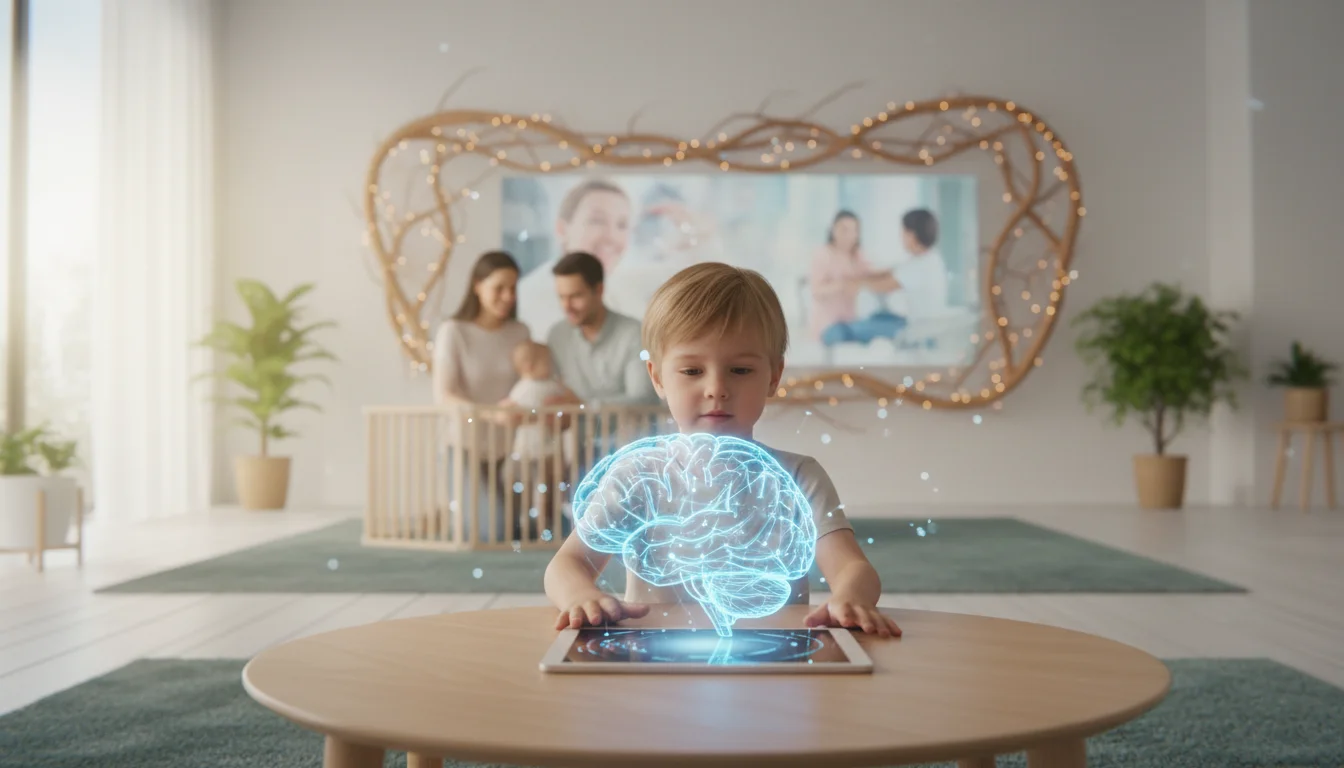
Beyond the Screen: A Psychologist’s Blueprint for Nurturing Your Child’s Brain in a Digital World
If you’re a parent today, you’re navigating a frontier no previous generation has faced: raising a developing human brain in an environment saturated with interactive, high-stimulation technology. The question isn’t just “how much screen time?” but a deeper, more urgent one: “What is this digital environment doing to the architecture of my child’s mind?” The guilt and anxiety you feel are valid, but they’re also a sign that your intuition—that a childhood should be about more than pixels—is correct. Let’s replace that fear with understanding and a practical plan.
I’m Dr. Anya Sharma, and in my clinical and research work, I’ve seen the full spectrum of technology’s impact. The goal isn’t to villainize screens, but to understand them as a powerful environmental factor, much like nutrition or sleep. We must learn to integrate them intentionally, so they don’t inadvertently hinder the critical, hardwired developmental milestones every child needs to hit.
The Developing Brain: A Construction Site, Not a Finished Product
To understand tech’s impact, we must first appreciate the magnificent, vulnerable project that is the young brain. From birth through adolescence, the brain is under rapid construction. Key processes include:
- Synaptic Pruning: Think of this as the brain’s “use-it-or-lose-it” principle. Neural connections that are frequently used become strengthened into efficient superhighways. Those that are neglected are pruned away. What we expose our children to directly shapes which pathways survive.
- Myelination: This is the process of insulating neural pathways with a fatty substance called myelin. It makes communication between brain regions faster and more efficient. The development of the prefrontal cortex—the CEO of the brain responsible for focus, impulse control, and emotional regulation—is one of the last areas to fully myelinate, often not until the mid-20s.
- Neuroplasticity: This is the brain’s remarkable ability to change and adapt based on experience. It’s highest in childhood, which is why early experiences are so foundational.
When we introduce technology, we are directly influencing these biological processes. The brain adapts to the input it receives. Fast-paced, rewarding, and passive input shapes a different brain than slow, effortful, creative, and socially interactive input.
The Digital Diet: What’s on the Menu Matters More Than Just Portion Size
While “screen time limits” are a crucial starting metric, they are like only counting calories without assessing nutritional value. A minute spent on a video call with grandma is neurologically worlds apart from a minute spent scrolling through rapid-fire, autoplay videos. We need a more nuanced “Digital Diet” framework.
| Digital “Food Group” | Brain Impact & Developmental Analogy | Parental Guidance Principle |
|---|---|---|
| Passive Consumption (Autoplay videos, non-interactive TV) | Promotes a passive, receptive brain state. Can hinder the development of executive function (sustained attention, task-switching) if it displaces active play. Analogous to a diet of only processed snacks. | Limit heavily, especially for under 2. Always co-view and narrate to add interaction. |
| Interactive & Creative (Drawing apps, coding games, digital music creation) | Can engage problem-solving, planning, and fine motor skills. The key is active creation versus passive consumption. Analogous to cooking a meal from fresh ingredients. | Choose high-quality, open-ended apps. Time-box sessions and ensure they complement, not replace, physical creation (e.g., also drawing with crayons). |
| Social & Communicative (Video chats, collaborative games with known friends) | Can support social connection and language development when it mirrors real-time, reciprocal interaction. Analogous to a shared family meal. | Prioritize real-time interaction over asynchronous messaging. Supervise and discuss social dynamics. |
| Algorithmically-Driven & Reward-Based (Social media feeds, infinite-scroll games, most YouTube) | Designed to exploit dopamine loops, training the brain for constant novelty and intermittent rewards. This can rewire reward pathways, making patience and sustained effort (like reading a book) feel less satisfying. Analogous to a diet high in addictive sugar. | Delay exposure as long as possible (ideally post-puberty). Have explicit, ongoing conversations about algorithmic design and its intent. |
The Four Pillars of Screen-Time Strategy: A Developmental Approach
Forget a one-size-fits-all rule. Your strategy should evolve with your child’s brain. Here is my four-pillar framework for setting developmentally-appropriate boundaries.
Pillar 1: The Pre-Operational Protector (Ages 0-5)
The core mission here is to protect time for the essential, three-dimensional work of childhood: sensory motor exploration, face-to-face interaction, and unstructured play. The American Academy of Pediatrics advises avoiding screens (except video chatting) for children under 18-24 months. For 2-5 year-olds, limit to one hour per day of high-quality, co-viewed content. The “co-viewing” is non-negotiable—it transforms passive watching into a social, language-building interaction. Your primary question: “Does this screen activity support or replace the hands-on play crucial for synaptic wiring?”
Pillar 2: The Executive Function Trainer (Ages 6-12)
This is the window to actively train the prefrontal cortex. Screens can be used as tools, but under a clear framework. Implement the Three-Tier Boundary System:
- Time Boundaries: Clear, consistent daily limits (e.g., 60-90 minutes on school days). Use physical timers, not the device’s.
- Space Boundaries: Public, high-traffic family zones only (kitchen, living room). No devices in bedrooms. Charge all family devices overnight in a common “charging station.”
- Context Boundaries: “First Things First.” Homework, chores, and physical play must be completed before any recreational screen time. This reinforces delayed gratification.
Pillar 3: The Identity & Autancy Navigator (Ages 13-18)
The teen brain is undergoing massive social and identity-based rewiring. The risk shifts from cognitive delay to the impact on self-worth, attention, and mood. Your role evolves from gatekeeper to coach. Have open dialogues about algorithmic curation, social comparison, and digital footprints. Encourage “digital self-audits” where they reflect on how different apps make them feel. Negotiate boundaries together, focusing on core needs like sleep (no devices in the bedroom remains critical) and in-person socializing.
Pillar 4: The Family Ritual Guardrails (All Ages)
This pillar is about proactively creating tech-free connection to fulfill the human needs screens often attempt to meet. Establish sacred, device-free times and zones:
- The First and Last Hour Rule: No screens for the first hour after waking or the last hour before bed. This protects sleep hygiene and morning routines.
- The Meal Sanctuary: All devices away during family meals, full stop.
- The Weekly Connection Hour: One hour per week dedicated to a non-digital family activity—a board game, a walk, cooking together. Protect this time like a critical business meeting.
When to Pause and Recalibrate: Your Parental Dashboard Warning Lights
Technology use becomes a developmental concern when it displaces essential childhood activities. Consider these “dashboard warnings” a sign to pause and recalibrate:
- If screen time consistently replaces sleep, physical activity, face-to-face social interaction, or hands-on creative play.
- If you see increased irritability, resistance, or meltdowns associated with transitioning off screens.
- If your child shows a declining interest in previously enjoyed offline activities.
- If you notice your own device use modeling constant partial attention, breaking your family’s established rules.
Remember, you are not managing a device; you are cultivating a brain. The occasional movie night or extra gaming hour isn’t the issue. It’s the consistent, cumulative pattern that shapes neural architecture.
FAQ: Your Top Questions on Tech and Child Brain Development, Answered
Q: Is educational TV or an app really that bad for my toddler?
A: For children under 2, even “educational” content is largely ineffective for learning. Their brains learn best through two-way, responsive interaction with a caring adult and through manipulating their physical world. A screen cannot replace that. After age 2, the educational value is entirely dependent on co-viewing and discussion.
Q: My teen says all their friends are on [Social Platform]. How do I hold my boundary?
A: Acknowledge the social pressure—it’s real. Shift the conversation from “I’m banning it” to “Let’s understand it.” Research the platform’s known risks together (e.g., cyberbullying features, data collection). You might agree to a trial with strict privacy settings and mandatory follow-up check-ins on their emotional experience. Your goal is to build their critical thinking, not just your control.
Q: I’m overwhelmed trying to model good behavior with my own phone use. Help!
A: This is the most common and honest struggle. Start with a family digital audit. For one week, everyone (parents included) tracks their screen use with a simple notepad. Then, have a non-judgmental family meeting about the results. Commit to one small, collective change—like all putting phones in a basket during dinner. Modeling self-regulation, including your own struggles, is a more powerful lesson than perfect hypocrisy.
Q: Are some children more susceptible to negative effects than others?
A> Absolutely. Children with existing attention, anxiety, or impulse control challenges can be more vulnerable to the overstimulating and habit-forming nature of certain digital content. For these children, a stricter “digital diet” with a strong emphasis on offline, regulating activities (like outdoor play) is often even more crucial. Consult with a child psychologist or pediatrician for personalized guidance.
The path forward is not a Luddite retreat, but a mindful integration. It’s about being the architect of your child’s daily experiences, ensuring the rich, slow, messy, and profoundly human activities that build a resilient, focused, and emotionally intelligent brain remain at the center. Your intentionality today is wiring their resilience for tomorrow. Start not by taking something away, but by proactively putting something wonderful in its place—your connected, present attention.
For further reading on evidence-based guidelines, I recommend the American Academy of Pediatrics’ HealthyChildren.org website. For a deep dive into the science of attention, Dr. Gloria Mark’s work on attention spans is invaluable. Additionally, Common Sense Media provides excellent, age-specific reviews and guidance on media content.



https://shorturl.fm/8N7AX
Imperium Sprey’in içeriğinde yer alan Ginseng özütü, kan akışını artırarak cinsel yetenekleri geliştirmektedir.
Yüzyıllar boyunca Asya tıbbında güç ve dayanıklılığın bir kaynağı olarak bilinen bu bitki, sağlık ve enerji artırıcı özellikleriyle tanınmaktadır.
Imperium Sprey satın al.