Beyond the Glare: How Blue Light Hijacks Your Sleep and Strains Your Eyes (And What to Do About It)
If you’re reading this after sunset, I want you to pause for a moment. Take a mental snapshot of your environment. Is there a TV on in the background? A smartphone within arm’s reach? A laptop open with unfinished work? For most of us, the answer is a resounding yes. We live in a world perpetually bathed in the cool, energetic glow of LEDs and screens. And while we’ve all heard the warnings about “blue light,” the conversation often stops at generic advice about screen filters. As a behavioral psychologist, I see a deeper story—one where this pervasive light isn’t just a nuisance; it’s a powerful environmental cue actively disrupting our most fundamental biological rhythms and family well-being.
Let’s start with empathy, not alarm. Feeling exhausted even after a full night’s “sleep”? Struggling with dry, irritated eyes at the end of a workday? Finding it impossible to wind down because your mind is still buzzing from a late-night scroll? You are not failing at wellness. You are navigating an environment that is, quite literally, working against your biology. My goal here is not to demonize technology but to empower you with an evidence-based understanding of blue light effects, transforming you from a passive recipient into an active architect of your family’s digital ecosystem. This is about intentional integration, not elimination.
Your Circadian Rhythm: The Internal Conductor We’re Silencing
Think of your circadian rhythm not as a simple sleep-wake cycle, but as the master conductor of your body’s entire orchestra. It regulates hormones that control hunger, mood, cellular repair, and, most critically, the sleep-wake cycle. For millions of years, this conductor took its primary cue from one source: the sun. The warm, long wavelengths of a sunset signaled the pineal gland in your brain to release melatonin, the “hormone of darkness,” gently ushering you toward sleep.
Enter artificial blue light—specifically, the high-energy visible (HEV) light in the 460-480 nanometer range emitted abundantly by our devices. Your eyes contain a special type of photoreceptor cell called intrinsically photosensitive retinal ganglion cells (ipRGCs). These cells are exquisitely sensitive to this blue wavelength. When they detect it—even through closed eyelids—they send a direct signal to the master conductor: “It’s daytime. Halt melatonin production. Be alert.”
This is the core of the problem. When we binge-watch a series or answer “just one more email” at 10 PM, we are flooding these receptors with a biological lie. We’re telling our internal orchestra it’s high noon, forcing the conductor to scramble. The result? A delayed and diminished melatonin release. You might fall asleep from sheer exhaustion, but the quality of that sleep—the deep, restorative stages where memory consolidation and physical repair occur—is often compromised. For families, this creates a ripple effect: groggy, irritable parents and children struggling to focus at school, all trapped in a cycle of poor sleep hygiene.
Computer Eye Strain: It’s More Than Just Tired Eyes
While sleep disruption is the headline-grabbing effect, the day-to-day experience for my clients—especially the Burned-Out Professional avatar—is digital eye strain, or computer vision syndrome. This isn’t just about feeling a little tired. It’s a specific constellation of symptoms driven by how we interact with blue light sources:
- Visual Fatigue: Your ciliary muscles work overtime to maintain focus on a fixed-distance, high-contrast plane for hours.
- Reduced Blink Rate: Studies show we blink up to 66% less often when staring at screens, leading to dry, gritty, and watery eyes as the tear film evaporates.
- Glare and Contrast Sensitivity: The sharp, direct emission of blue light can cause discomfort, headaches, and difficulty shifting focus from screen to distance.
The behavioral component is key here. We don’t just look at our devices; we lean into them. We become hyper-focused, our posture collapses, and our blink rate plummets. This creates a perfect storm of physical strain. It’s a tangible, daily reminder of our technology’s physical impact, making it a critical entry point for positive change.
The Family Digital Lighting Plan: A 3-Tier Strategy for Reclaiming Your Night
Generic advice like “avoid screens before bed” often fails because it’s all-or-nothing. Based on clinical work with families, I propose a more sustainable, tiered framework. Think of it as creating “lighting zones” in your home, much like you have designated spaces for eating, playing, and sleeping.
| Tier | Zone & Time | Actionable Strategy | Psychological & Biological Benefit |
|---|---|---|---|
| Tier 1: The Wind-Down (90 mins before bed) | Bedrooms, Living Room | Activate device “Night Shift” or “Blue Light Filter” to maximum warmth. Institute a family “device curfew” where all personal screens go into a common charging station. Switch to warm, dimmable lamps (under 3000K color temperature). | Signals the ipRGCs that sunset is occurring. Allows melatonin to begin its natural rise. Creates a predictable, calming ritual that eases the transition to sleep. |
| Tier 2: The Evening Engagement (Post-dinner) | Common Areas | For shared screen time (family movie), use a blue-light filtering app on the streaming device. Encourage non-digital activities under warm light: board games, reading physical books, conversation. | Protects the family’s collective circadian rhythm while allowing for shared leisure. Strengthens interpersonal bonds through cooperative, offline play. |
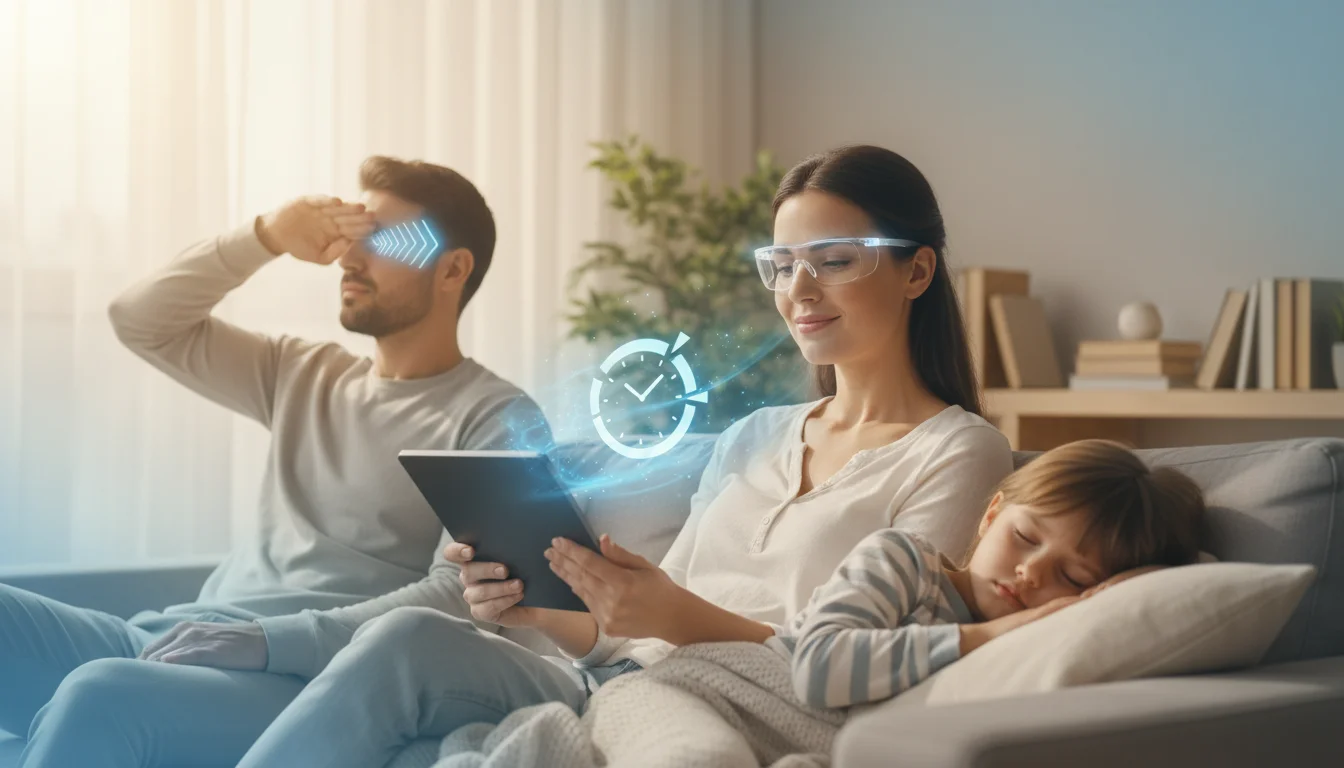
| Tier 3: The Unavoidable Digital Hour (Late work/study) | Home Office | Mandatory use of 20-20-20 rule (every 20 mins, look 20 ft away for 20 sec). Install flux or a similar system-wide tinting software. Consider blue-light blocking glasses with a clear or light yellow tint for this specific task. | Minimizes acute melatonin suppression and eye strain when work must be done. The glasses provide a physical barrier and a behavioral cue that “this is work mode, not relaxation mode.” |
Sleep Hygiene Tips That Actually Work in the Digital Age
Sleep hygiene must evolve for the modern environment. It’s not just about a good mattress; it’s about curating your light diet.
- Conduct a “Light Audit”: Walk through your home at night. Identify and eliminate “light leaks”—the charging LED on the gaming console, the bright alarm clock, the hallway nightlight that shines into a room. Replace with red-spectrum nightlights, which have the least impact on ipRGCs.
- Embrace the “Sunrise Simulation”: If blue light at night is bad, its counterpart—morning blue light—is beneficial. Seek it out! Open blinds upon waking or consider a dawn-simulating alarm clock. This reinforces a strong circadian signal, making you more alert in the AM and more primed for sleep at night.
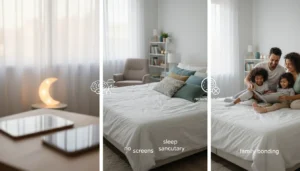
- Reframe the Bedroom: Advocate fiercely for the bedroom to be a “Somatic Sanctuary”—a place only for sleep and intimacy. This is non-negotiable for good sleep hygiene. Remove TVs and, if possible, charge devices outside the room. This builds a powerful associative link between the environment and rest.
Protecting Young Eyes: A Developmental Perspective
For the Concerned Parent, the stakes feel higher with children. Their eyes’ lenses are clearer, potentially allowing more HEV light to reach the retina. More critically, their circadian systems are still developing. Establishing healthy patterns early is a profound gift. For younger children, make device curfews a non-negotiable family rule. For Identity-Seeking Teens, who often do homework digitally and socialize online, collaborate. Don’t dictate. Explain the “why” using the conductor analogy. Co-create solutions: “I know you need to study late. Let’s get those blue-light filtering glasses for your laptop sessions, and we’ll both put our phones in the kitchen at 10 PM.” This approach respects their autonomy while safeguarding their biology.
FAQ: Your Blue Light Questions, Answered by a Behavioral Psychologist
Q: Are blue light glasses a scam?
A: They are a tool, not a cure-all. For specific, task-based use in the evening (like late work), amber-tinted glasses have been shown in studies to improve melatonin levels and sleep quality. However, they are not a license for unlimited screen time. The most effective strategy is reducing bright light exposure overall.
Q: Is the “Night Mode” on my phone enough?
A> It’s an excellent first step, but it’s only part of the solution. It reduces blue emission but still delivers bright light and engaging content that stimulates your mind. Always pair it with a behavioral rule, like no social media or email in that mode.
Q: Can I reverse the effects of years of late-night screen use?
A> Absolutely. The circadian rhythm is remarkably resilient. Consistency is key. By implementing the Family Digital Lighting Plan for just 1-2 weeks, most people report significantly improved sleep onset and quality. Your body wants to find its rhythm; you just need to give it the right cues.
Q: What about e-readers like a Kindle?
A> Devices with front-lit e-ink displays (like a standard Kindle with its light on) still emit some blue light. However, the experience is fundamentally different from a tablet: it’s non-interactive, less stimulating, and typically used for a single, calming activity. For dedicated reading, it’s a good middle-ground, especially with a warm light setting.
The path forward isn’t found in fear or drastic bans. It’s built on mindful awareness and small, intentional shifts. By understanding the blue light effects on your internal conductor, you can stop working against your biology and start designing evenings that truly restore. Start tonight with just one Tier of the Lighting Plan. Notice the difference in how you feel as you climb into bed. That moment of calm, that easier drift into sleep—that’s the sound of your own internal orchestra, finally playing in harmony once again.
For further reading on circadian rhythm science, I recommend the work of Dr. Satchin Panda at the Salk Institute. To understand the data behind digital eye strain, the American Optometric Association provides excellent resources.