
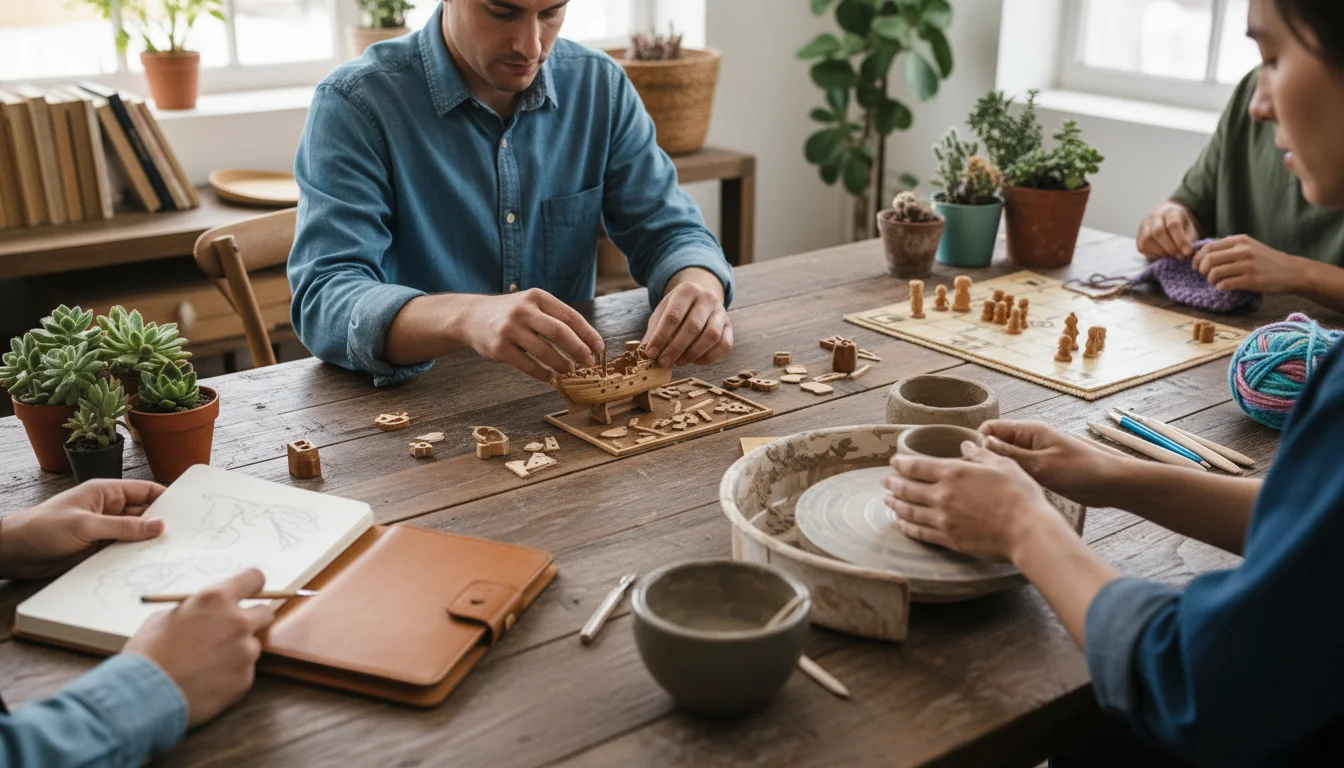
Feeling the Digital Static? It’s Your Brain Craving a Different Kind of Signal.
If you’re reading this, you likely know the feeling all too well. That low-grade hum of fatigue behind your eyes after a day of screens. The subtle anxiety of a phone left in another room. The strange paradox of being hyper-connected yet profoundly disconnected from your own hands, your surroundings, and the people physically next to you. As a behavioral psychologist, I want to start by saying this: what you’re feeling is not a personal failing. It’s a neurobiological and psychological response to an environment our brains did not evolve for. Your craving for something “tech-free” is a healthy signal—a sign that a core human need for tangible, analog experience is being undernourished.
Today, we’re moving beyond the simplistic idea of a “digital detox.” Instead, we’re engaging in what I call Intentional Analog Integration. This isn’t about shaming your tech use or demanding you live in a cabin without Wi-Fi. It’s about strategically introducing counter-balancing activities that satisfy deep psychological needs that pixels simply cannot. We’ll explore tech-free hobbies not as a punishment, but as a form of cognitive and emotional nourishment, essential for the modern adult’s digital minimalism toolkit.
The Psychological “Why”: What Analog Activities Provide That Screens Can’t
Before we dive into the “what,” let’s firmly establish the “why.” Understanding the science transforms a hobby from a mere pastime into a targeted wellness strategy. Engaging in physical, non-digital activities addresses several critical areas:
Tactile Feedback & Proprioception: Screens offer a flat, two-dimensional experience. Our sense of touch is limited to a smooth glass surface. Analog hobbies—whether kneading dough, planting seeds, or sanding wood—flood the brain with rich, varied tactile information and proprioceptive input (awareness of your body in space). This grounds the nervous system, reduces anxiety, and enhances present-moment awareness.
The Mastery Gradient: Digital interfaces are designed for instant, often shallow, gratification (likes, level-ups). True skill-building follows a slower, more rewarding gradient. The frustration of a botched pottery bowl or a sourdough loaf that didn’t rise teaches resilience, patience, and ultimately delivers a profound sense of self-efficacy that no virtual achievement can match.
Uninterrupted Flow State: The constant ping of notifications is the arch-enemy of the “flow state,” that blissful zone of deep concentration where time falls away. Analog hobbies, by their very nature, remove these digital interruptions, allowing your prefrontal cortex to relax into sustained focus, which is deeply restorative and boosts creative problem-solving.
Embodied Cognition: This is a key concept in my work. It means our thinking isn’t just in our heads; it’s influenced by our physical bodies and actions. Writing by hand, for example, engages different neural pathways than typing, leading to better memory retention and idea formation. Analog living literally helps you think differently.
The Intentional Integration Framework: Choosing Your Analog Anchor
Don’t feel pressured to overhaul your life. We start with one anchor activity. Use this simple framework to choose yours:
- Identify the Need: What is your dominant digital drain? Is it mental clutter (need for focus), emotional fatigue (need for joy), or physical stagnation (need for movement)?
- Match the Modality: Pair the need with an activity type. Mental clutter might need a hands-on, repetitive task like knitting. Emotional fatigue might call for something expressive like painting. Physical stagnation demands something that gets you outdoors or using your body.
- Start Micro: Commit to 20 minutes, twice a week. The barrier to entry must be laughably low. The goal is consistency, not marathon sessions.
- Create a Ritual: Pair the activity with a specific context to cue the habit. “Every Sunday morning with my coffee, I sketch.” This ritualization leverages behavioral chaining to make it stick.
A Curated Catalog of Cognitive Counterweights: Tech-Free Hobbies for Adults
Here is a selection of activities, organized by the primary psychological benefit they offer. Consider this a menu for your mind.
| Hobby Category | Primary Psychological Benefit | Beginner-Friendly Entry Point | Mindset Shift Required |
|---|---|---|---|
| Handcrafts & Fiber Arts (Knitting, Embroidery, Weaving) | Induces a meditative, focused state; reduces cortisol; provides tangible, completable projects. | A simple scarf kit or a pre-stamped embroidery hoop. | |
| Analog Audio & Music (Vinyl Record Collecting, Learning an Acoustic Instrument) | Forces active, intentional listening; creates a shared physical experience; builds delayed gratification. | A budget turntable and one cherished album. A ukulele and online tabs (learned away from the screen!). | Move from background noise to foreground experience. Listen to a whole album, side A to side B. |
| Nature Journaling & Foraging | Combines mindfulness, outdoor immersion, and the science of “awe”; deeply grounding. | A pocket notebook and a guide to local trees or birds. A class on identifying edible weeds. | Become an observer, not just a passerby. See your local environment with new, curious eyes. |
| Board Games & Complex Puzzles | Facilitates deep social connection, strategic thinking, and cooperative problem-solving without a screen intermediary. | Reclaim play as a vital adult activity, not just child’s fare. | |
| Bread Baking & Fermentation | Connects you to biological processes and time; teaches patience and offers visceral, sensory rewards. | A no-knead bread recipe. Making your own sauerkraut in a jar. | Work with living cultures. Accept that some variables (room temp, humidity) are outside your control. |
| Amateur Astronomy & Stargazing | Cultivates perspective, humility, and wonder; inherently forces disconnection from terrestrial concerns. | A pair of binoculars and a star chart app (use it to learn, then put it away to look up). | Slow down to cosmic time. Your to-do list is irrelevant under the vastness of the night sky. |
Beyond the Hobby: Cultivating an Analog Ecosystem
Your chosen hobby is the entry point, but the true transformation happens when you let its principles bleed into your daily life. This is digital minimalism in action.
- The Analog Interlude: Replace the 15-minute doomscroll with 15 minutes of sketching, whittling, or just sitting with a cup of tea and observing the light in the room. These micro-doses of analog time reset your attention span.
- Create Physical Artifacts: In a world of cloud storage and digital photos, make something physical. Print your best photos of the year into a book. Write a letter by hand. The tangibility of the artifact carries emotional weight a file cannot.
- Embrace “Good Enough” & Imperfection: The digital world is editable, filterable, and perfectible. The analog world is gloriously messy. Your pottery will be lopsided. Your garden will have weeds. This isn’t failure; it’s a lesson in embracing the beautiful constraints of reality, which is a powerful antidote to the curated perfection of social media.
FAQ: Navigating Common Hurdles to Analog Living
Q: I’m too busy. How can I possibly add one more thing?
A: This is the most common concern. Reframe it not as “adding” but as “replacing.” This is about a substitution strategy. Audit your screen time data. That 35 minutes on a social media app after dinner? That’s your analog time, already budgeted. You’re not finding time; you’re reallocating cognitive resources.
Q: I get frustrated when I’m not immediately good at something. I just give up.
A: This is the digital instant-gratification loop talking! You must consciously practice self-compassion. The goal is engagement, not expertise. In my clinical practice, I often advise clients to literally celebrate the mistake—the dropped stitch, the misspelled word in a handwritten note. It’s proof you’re operating in the real, human world.
Q: Don’t many of these hobbies require learning from online tutorials? Isn’t that cheating?
A: Absolutely not! This isn’t about Luddism. Technology is a tool. The key is intentionality. Watch a tutorial to learn a knitting stitch, then put the device away and practice for an hour. The device serves the analog activity; it doesn’t interrupt or run parallel to it. The boundary is in how you use it.
The path to digital wellness isn’t paved with deleted apps alone. It’s built with the physical materials of a life lived intentionally in three dimensions. Your tech-free hobby is more than a distraction; it’s an act of neural rebellion. It’s a statement that your attention, your time, and your sense of mastery belong to you, not to an algorithm designed to capture them.
Start small. Be kind to yourself. Pick one thing from the menu that sparks a flicker of curiosity, not a sense of obligation. That flicker is your authentic self, reminding you that joy and connection exist in the texture of reality, waiting for you to look up and reach out.



Learned a lot here! Would love a deeper dive into peptide shelf life.