Beyond Unplugging: How to Design Intentional Sanctuaries in Your Digitally-Saturated Home
If you’re reading this, I imagine you’re feeling a quiet, persistent hum of dissatisfaction. It’s the feeling during a family dinner when someone glances at a phone, breaking the fragile thread of conversation. It’s the sigh of relief-turned-guilt when you hand a tablet to a child just to get a moment of peace. It’s the way your bedroom, once a sanctuary, now feels like an annex of your office with its glowing charger lights. You’re not seeking to wage war on technology—you know that’s neither practical nor desirable. What you’re yearning for are sanctuaries. Spaces where connection, rest, and presence aren’t competing with a notification. As a behavioral psychologist, I can tell you this isn’t just a nice idea; it’s a critical strategy for cognitive restoration and relational health. Today, we move beyond generic “no screens” rules and build a psychologically-grounded framework for creating true tech-free zones that stick.
The Sanctuary Effect: Why Physical Space Dictates Mental State
Behavioral science shows us that our environment is the single greatest predictor of our behavior. We are creatures of context. The mere presence of a smartphone on a table, even if face down, reduces cognitive capacity and the quality of face-to-face conversation, as studies from the University of Texas have demonstrated. Your brain is subconsciously allocating attention to it, a phenomenon called “brain drain.” Therefore, creating a tech-free zone isn’t about deprivation; it’s about architecting your environment for the mental state you desire. Think of it as creating a “psychological airlock.” When you cross the threshold into that space, your mind receives a clear signal: “Shift modes. Here, we connect. Here, we rest. Here, we are present.” This intentional design is what separates a sustainable practice from a short-lived, willpower-dependent rule.
The Tiered Sanctuary Framework: A Blueprint for Every Home
One-size-fits-all rules fail because families have different layouts, rhythms, and needs. My Tiered Sanctuary Framework provides structure with necessary flexibility. We’ll categorize zones not just by room, but by their primary psychological purpose.
| Tier | Sanctuary Zone | Core Psychological Purpose | Key Implementation Strategy |
|---|---|---|---|
| Tier 1: Non-Negotiable Core | The Dining Table & The Bedroom | Nourishing Attachment & Secure Rest | Physical Device Drop-Station outside the zone. |
| Tier 2: Connection Catalysts | Living Room (specific areas), The Car | Fostering Spontaneous Interaction & Focused Conversation | “Tech-in-Common” rule & Purposeful Exceptions. |
| Tier 3: Personal Renewal Nooks | A Reading Chair, Porch, Workshop, Garden | Facilitating Solitary Flow & Uninterrupted Thought | Curated Analog Toolkit in the space. |
Implementing Your Tier 1 Core Sanctuaries
These zones are the bedrock of your family’s digital wellness. Their violation most directly harms fundamental human needs.
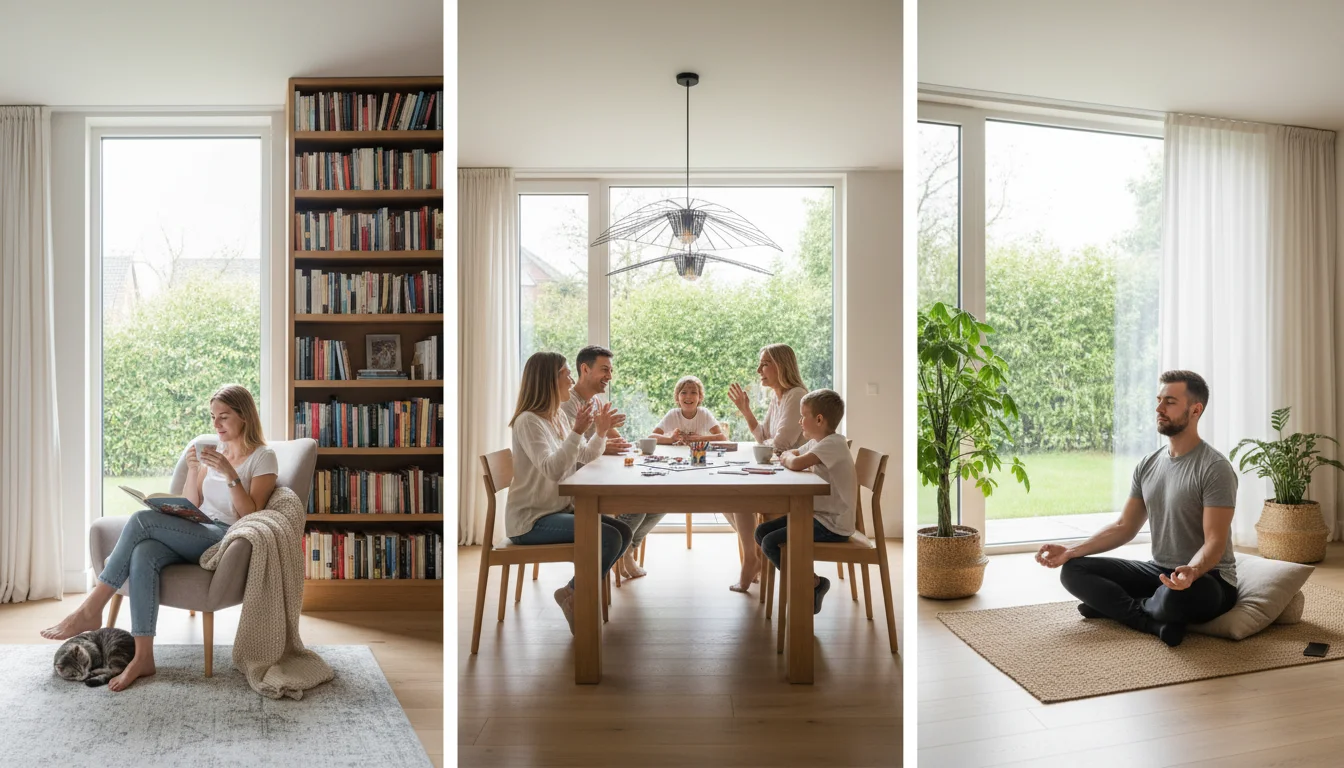
- The Dining Table: Reclaiming the Family Narrative. This isn’t just about family dinner rules; it’s about protecting the primary space where family identity is built through shared stories. The rule is simple: No devices at the table, period. This includes parents. The implementation secret is the “Drop-Station.” Designate a basket, shelf, or charging station in another room where all devices go before sitting down. This physical action is a ritual that signals a mental shift. To ease the transition, introduce conversation sparks: “What was your ‘high’ and ‘low’ today?” or “If you could have any superhero power for a week, what would it be?”
- The Bedroom: Guarding the Gate of Sleep and Intimacy. For adults and children alike, the bedroom must be a haven for sleep and, for couples, emotional and physical intimacy. The blue light from screens disrupts melatonin production, but the psychological intrusion is worse. A work email checked from bed turns your sleep space into an anxiety zone. Implement a “Bedroom Charging Station” outside the door. Use an old-fashioned alarm clock. This is a profound digital detox for parents that models boundary-setting for children. For teens, this is a harder but crucial negotiation. Frame it as their right to uninterrupted, quality sleep—essential for their mood, academic performance, and health.
Curating Tier 2 & 3 Zones for Sustainable Adoption
Core zones establish the norm, but these secondary zones weave digital intentionality into the fabric of daily life.
- The Living Room (Connection Catalyst): Instead of a blanket ban, try the “Tech-in-Common” rule. If media is consumed, it’s done together on a shared screen (e.g., watching a movie, playing a console game). This transforms passive consumption into potential connection. Designate a specific chair or couch corner as “Analog Only”—a place for reading physical books, knitting, or chatting without a device in hand.
- The Car (Mobile Sanctuary): Transform short trips into conversation goldmines. Declare the car a “No Personal Device” zone. Use the time for silly podcasts the whole family enjoys, playing “I Spy,” or simply talking without eye contact (which can sometimes make teens more open). For longer trips, schedule “device breaks” rather than defaulting to constant screen use.
- Personal Renewal Nooks (Tier 3): This is for every family member. Identify a small space—a window seat, a garden bench, a workshop stool—and designate it for uninterrupted, screen-free activity. Stock it with the tools for an analog hobby: sketchbooks, a guitar, gardening gloves, puzzle books. This teaches the invaluable skill of cultivating internal boredom, the precursor to creativity and self-reflection.
The Parental Paradox: Modeling the Behavior You Want to See
Here lies the most common point of failure. We cannot mandate for our children what we do not practice ourselves. Your own digital detox for parents is not a separate project; it is the cornerstone of the entire family system. When you jump at every notification, you model that external alerts are more important than the people in front of you. Start with self-audit. Use your phone’s digital wellbeing features to see your own usage patterns. Then, be transparent. Say, “I’ve noticed I’m on my phone too much when I’m with you. I’m creating a zone for myself too, so I can be more present.” This vulnerability is powerful. It moves the family from a dynamic of enforcement to one of shared, collaborative wellbeing.
Navigating Resistance and Cultivating Buy-In
Resistance, especially from teens, is a sign the system is being tested, not that it’s wrong. Your response is key.
- Collaborate, Don’t Dictate: For older children and teens, involve them in designing the zones. Ask, “Where do you think we should all be more present together?” Let them have a say in the “Drop-Station” location or the living room rules.
- Focus on the “For,” Not Just the “Not”: Always frame the rule by what it creates. “The dinner table is phone-free for better conversation and to hear about your day,” not just “no phones allowed.”
- Grace Over Perfection: If a work call must be taken from the bedroom in an emergency, acknowledge the exception. The goal is the trendline, not perfect compliance. What matters is the shared family value you are consistently reinforcing.
By establishing these intentional sanctuaries, you are doing more than reducing screen time. You are actively building a family culture that values presence, teaches attention regulation, and safeguards the quiet spaces where individual identity and deep relationships can truly flourish. You are declaring that in a world designed to pull you apart, your home will be the place that pulls you together.
FAQ: Navigating Common Tech-Free Zone Challenges
Q: What if my teen says they need their phone for homework in their room?
A: This is a valid concern. Differentiate between creation and consumption/distraction. A laptop for writing a paper is a tool. The phone next to it is a portal to distraction. Advocate for a “distraction-free protocol” during focused homework time: phone in another room on Do Not Disturb, using browser extensions to block social media sites. The bedroom can be for focused work, but the phone rule for sleep still stands.
Q: My partner is the biggest resistor. How do I approach this?
A: Lead with empathy, not accusation. Use “I feel” statements: “I feel disconnected when we’re both on our phones at dinner, and I miss talking to you.” Suggest a small, time-bound experiment: “Could we try a phone-free dinner for just one week and see how it feels?” Often, experiencing the positive benefit is more convincing than any argument.
Q: Are smart speakers (like Alexa) allowed in tech-free zones?
A: This is a nuanced “it depends.” If used intentionally for a specific purpose—playing ambient music during dinner or setting a timer—it can be a shared tool. If it becomes a source of constant interruptions (“Alexa, what’s the weather?”), it violates the sanctuary principle. Assess its impact on the human interaction in the space.
Q: Where can I learn more about the research behind this?
A> I recommend the work of Dr. Sherry Turkle at MIT on conversation and connection, explored in her book Reclaiming Conversation. For data on tech’s impact on adolescent development, the ongoing research by the Harvard T.H. Chan School of Public Health is an excellent resource. For practical family tools, Common Sense Media offers family media agreement templates.