
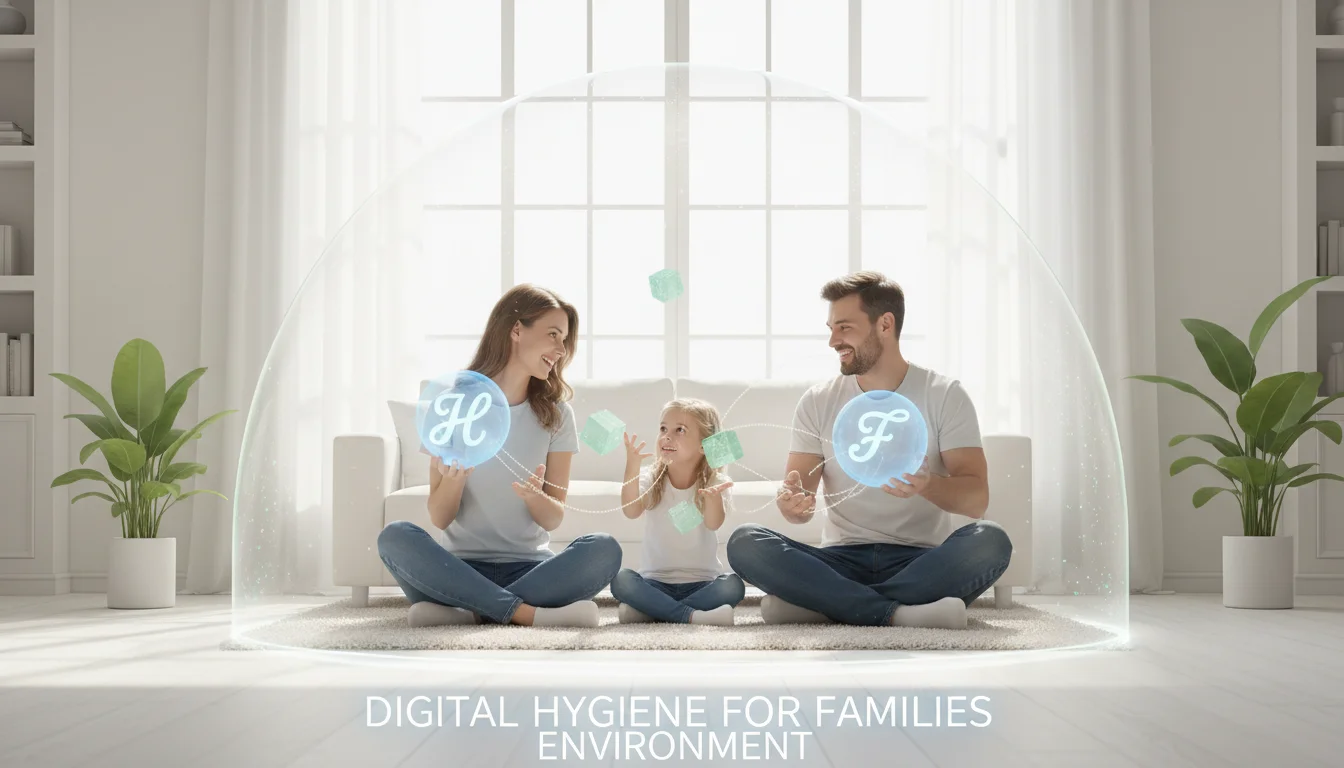
Your Family’s Digital Environment is the New “Air Quality” – It’s Time for a Spring Cleaning of the Mind
If I asked you to describe the air quality in your home, you might think of dust, pet dander, or pollen. You’d take steps to clean it. But what about your family’s digital environment? This intangible space—composed of endless notifications, autoplaying videos, social comparison feeds, and work emails bleeding into bedtime—is the psychological air your family breathes every day. And just like physical air, when it’s cluttered and polluted, it affects everyone’s health: focus frays, anxiety ticks up, and genuine connection becomes harder to find.
The old conversation about “screen time limits” is like trying to fix air quality by just turning off one appliance. It’s a piece of the puzzle, but it misses the systemic nature of the problem. True digital hygiene isn’t about counting minutes with a stopwatch; it’s about cultivating intentionality and health at the point of interaction with our devices. It’s the daily practices that keep our digital spaces—and by extension, our mental spaces—clean, organized, and conducive to the life we want to live.
As a behavioral psychologist, I see families stuck in a cycle of guilt and reactionary rule-making. It’s exhausting. The solution lies not in stricter policing, but in co-creating a sustainable system. Today, we’re moving beyond fear-based restrictions and building a proactive Family Digital Hygiene Framework. This isn’t a one-time detox; it’s the routine maintenance that prevents the need for a major overhaul.
Rethinking the Foundation: From Screen Time to Interaction Quality
The first step in upgrading your family’s digital hygiene is to shift the metric of success. Let’s retire the singular focus on “screen time.” Research from places like the Stanford Center for Digital Mental Health increasingly shows that how we use technology matters more than sheer duration. An hour of video-chatting with a grandparent is fundamentally different for the brain and for relationships than an hour of fragmented, passive scrolling.
We need a new lens. I guide families to assess their digital hygiene across three core dimensions, which I call the Interaction Quality Triad:
- Intentionality vs. Impulse: Is the device use a deliberate choice (“I’m going to watch one episode of this show to relax”) or a reflexive, unconscious grab (“I’m bored, let me just check my phone”)? The impulse habit is the primary source of digital clutter.
- Creation vs. Consumption: Is the activity adding something to the digital ecosystem or merely absorbing it? Creating a digital art project, coding a simple game, or even thoughtfully commenting on a friend’s post engages different cognitive muscles than mindless consumption.
- Connection vs. Comparison: Does the use facilitate genuine human connection (a shared laugh over a meme, planning an event) or fuel social comparison and identity anxiety (scrolling curated highlight reels)? This is the crucial distinction for teen and adult mental health alike.
By starting conversations around these three axes, you depersonalize the conflict. It’s no longer “You’re on your phone too much,” but “It feels like our tablet time has been more about consumption lately. What’s one creative thing we could do with it this weekend?”
The Living Document: Building Your Family Media Protocol
Forget the rigid “contract” that gets signed once and forgotten. We’re building a Family Media Protocol—a living document that evolves as your family does. Its power is in the collaborative process, not just the rules on the page.
Here is a foundational template to adapt. Use it as a discussion starter, not a decree.
| Protocol Area | Family Goal | Practical Implementation (Examples) | Adult Accountability Note |
|---|---|---|---|
| Digital-Free Zones & Times | To protect sacred spaces for connection and rest. | No devices at the dinner table (not even nearby). All family devices charge overnight in a common “charging station” outside bedrooms. The first 30 minutes after coming home/work/school are device-light for reconnection. | This is non-negotiable for adults too. You are the model. Your phone during dinner undermines the entire system. |
| Notification Hygiene | To reclaim focus and reduce ambient anxiety. | Family “Do Not Disturb” challenge: Turn off all non-essential app notifications for one week. Keep only people (calls/texts from family) and critical apps (e.g., school alerts). Discuss how it felt. | Explain the “attention economy” to older kids. You’re not being rude by ignoring pings; you’re protecting your mental focus for what you choose. |
| Content & Algorithm Awareness | To build critical thinking and curate a healthier digital diet. | Quarterly “Feed Clean-Up”: Sit together (age-appropriately) and review followed accounts/subscriptions. Unfollow sources that consistently cause negative feelings. For teens, discuss: “Does this account inspire you or make you feel inadequate?” | Share your own process. “I unfollowed that news page because it was making me feel constantly angry. I’m choosing to get my news from X instead.” |
| The “Why Before I” Check | To build the muscle of intentionality. | Practice verbalizing or thinking the purpose before unlocking. “I’m picking up my phone to… check the weather for tomorrow / text Mom back / look up a recipe.” This simple pause breaks the autopilot cycle. | Make this a family game. Call out friendly “Why Before I?” reminders to each other without judgment. |
The Weekly Connection Audit: Your Hygiene Maintenance Ritual
A system without maintenance fails. I recommend a brief, 15-minute Weekly Connection Audit. This is not a gripe session, but a strategic check-in. Frame it as “How is our digital environment serving us this week?” Use the Triad as a guide.
- “Did we have any moments of great intentional use this week? (e.g., Family movie night, looking up how to fix the bike together)”
- “Did we balance consumption with any creation?”
- “What was one online connection that felt good? Was there a moment of comparison that we can learn from?”
This audit allows you to tweak your Protocol. Maybe you realize the evening charging station is causing anxiety for a teen who uses their phone as an alarm. Solution: Invest in a standalone alarm clock. The protocol adapts. This flexibility is key to long-term buy-in.
When the “Clean-Up” Feels Overwhelming: Start With Micro-Habits
If your family’s digital clutter feels like a hoarder’s garage, the prospect of cleaning it can lead to paralysis. Don’t try to overhaul everything. Start with what I call Digital Hygiene Micro-Habits—small, almost effortless actions that create momentum.
- The Notification Ninja: Pick one day. For every non-essential notification you get, take 10 seconds to go into that app’s settings and turn it off permanently. Do this as you receive them.
- The Launchpad Reset: Change your phone’s home screen. Remove all social media and entertainment apps. Leave only tools (maps, calendar, notes, camera) and perhaps one or two communication apps. Force yourself to search for or intentionally navigate to distracting apps.
- The Connection Catalyst: Use a device to actively plan an offline connection. Instead of scrolling Instagram, text a family member: “Saw this recipe, want to try it with me this weekend?” or “This meme reminded me of you. Coffee soon?” You’re using the tool to bridge back to the physical world.
These small wins build a sense of agency. They prove that you can curate your digital environment, rather than being passively curated by it.
FAQ: Your Digital Hygiene Questions Answered
Q: My teen says everyone is on Discord/Snapchat all the time. If we set boundaries, they’ll be left out. How do we handle FOMO?
A: This is a real social cost. Acknowledge it. Don’t dismiss it. Then, problem-solve collaboratively. The goal isn’t isolation, but sustainable participation. Can you agree on “on-call” hours for social apps, followed by focused offline time for homework or family? Empower them by discussing the trade-off: “Constant access might mean you never miss a joke, but it also means you can’t deeply focus on your guitar practice, which you love. How can we design a schedule that honors both needs?”
Q: My spouse and I are on different pages about tech use. It causes conflict. How do we get aligned?
A: This is common. Schedule a calm, device-free conversation using the Interaction Quality Triad as a neutral framework. Instead of “You’re always on your phone,” try: “I’ve noticed our weekend mornings have become more about individual scrolling than connecting. I miss our pancake breakfast chats. What’s one small shift we could make?” Focus on the shared value (connection) and co-create a tiny, mutual first step.
Q: Are there any tools you actually recommend?
A: My philosophy is to use native device settings first—they’re free and powerful. Master iOS Screen Time or Android Digital Wellbeing features to understand your own usage patterns. For families, I often suggest tools that promote awareness and agreement over top-down control. For older children, a collaborative app like the Common Sense Media family agreement tool can structure the conversation. For understanding the science, resources from the Stanford Digital Medic project are excellent. Remember, the best tool is the ongoing, empathetic conversation.
Ultimately, digital hygiene is the ongoing practice of aligning your digital tools with your family’s values. It’s not about achieving a state of perfect, screen-free purity. That’s neither realistic nor desirable in our modern world. It’s about ensuring that your technology serves as a useful tool—a clean, well-organized drawer in your home—rather than a chaotic, overflowing junk drawer that spills stress and distraction into every room.
Start small. Pick one micro-habit or one box from the Protocol table. Have the first audit. Your family’s mental air quality is worth the investment. By cleaning your digital environment together, you’re not just setting rules; you’re building the psychological skills of intentionality, self-regulation, and mindful connection that will serve your children, and you, for a lifetime.



b55myf