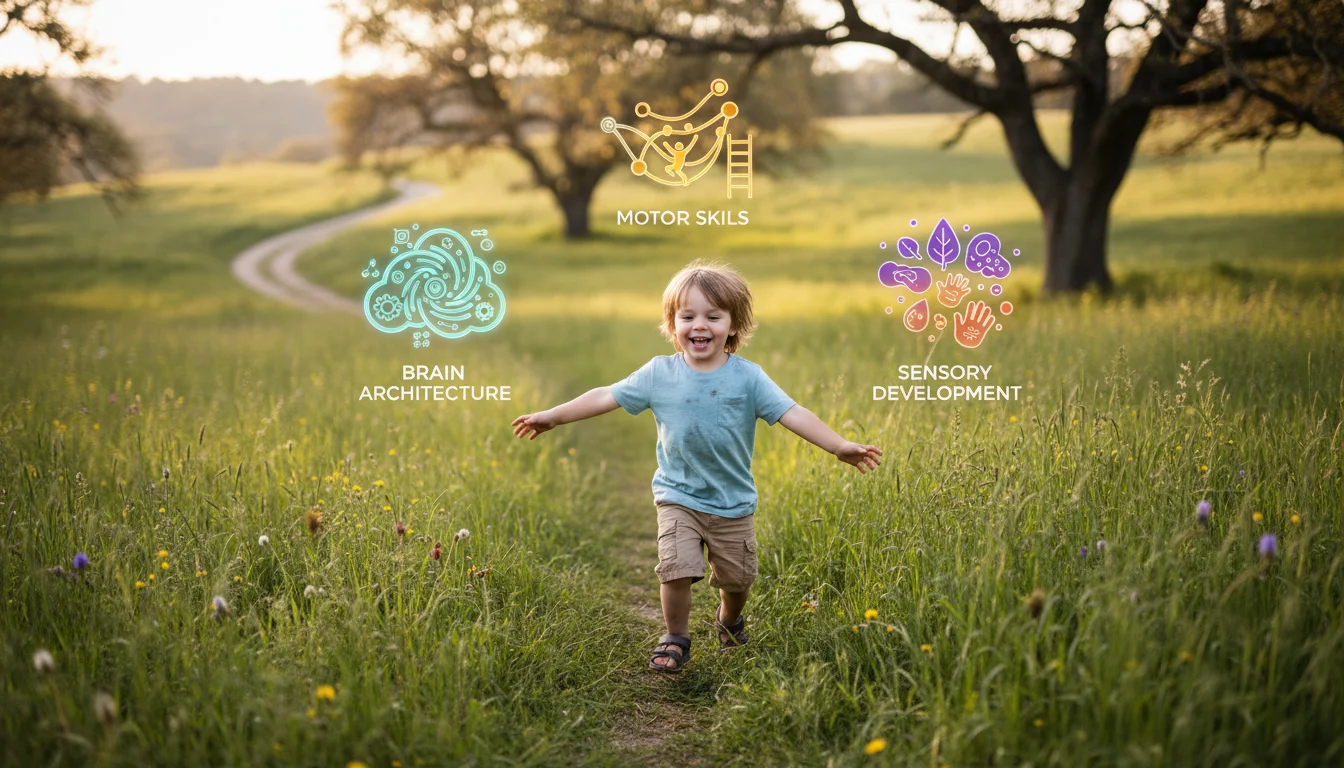
Beyond the Screen: Why Outdoor Play Isn’t Just Recess, It’s Essential Brain and Body Architecture
If you’re a parent feeling that subtle, persistent tug of guilt when you shoo your kids outside, I want you to pause that feeling right now. That instinct isn’t just about getting them out from underfoot or giving your ears a break from the latest viral game soundtrack. It’s a deep, psychological wisdom—a recognition that the green space beyond your window is not merely a backdrop, but an active, dynamic partner in your child’s development. In my work with families navigating digital saturation, I’ve come to see unstructured outdoor play not as the opposite of screen time, but as its most powerful and necessary counterbalance. It’s less about “unplugging” and more about plugging into a different, more ancient source of nourishment.
We often frame outdoor play as a simple physical benefit—”go burn off some energy!”—but this drastically undersells its role. From a behavioral psychology and developmental standpoint, outdoor play is a primary catalyst for integrated growth. It’s where motor skills, sensory processing, emotional regulation, and cognitive executive functions are woven together in real-time. Today, let’s move beyond the generic advice and explore the evidence-based blueprint for why the backyard, the park, and the trail are irreplaceable tools for building resilient, focused, and healthy young minds.
The Sensory Symphony: Nature as the Ultimate Developmental Gym
Indoor environments, even well-designed playrooms, are sensory-limited. Floors are flat, temperatures are controlled, and inputs are predictable. The outdoors, in contrast, is a rich, unpredictable sensory symphony. This isn’t just poetic; it’s neurologically critical. This concept, often called nature therapy or “sensory integration in natural environments,” is foundational.
When a child navigates a uneven path, their proprioceptive system (awareness of body in space) is engaged. Balancing on a log activates the vestibular system (balance). Feeling mud squish between fingers, the breeze on skin, and smelling damp earth provides tactile and olfactory input that screens simply cannot replicate. This diverse sensory diet does more than entertain; it builds a more robust and adaptable nervous system. Research indicates that children who engage in regular, unstructured outdoor play show improved ability to filter out distractions and regulate their emotional responses—skills that are directly compromised by excessive, passive screen consumption.
Motor Skills: From Gross to Fine, Built by Adventure
The term “motor skills” gets thrown around, but let’s break down what’s really happening outside. We can think of it as a three-tiered system:
- Gross Motor Mastery (The Big Moves): This is the most visible benefit. Running, jumping, climbing, rolling down a hill. These activities build core strength, cardiovascular health, and coordination. But crucially, they also build risk-assessment and resilience. A child learns to gauge how high they can climb, how fast they can run on gravel, and how to fall safely. This is embodied confidence-building.
- Perceptual-Motor Integration (The Brain-Body Link): This is where it gets fascinating. Throwing a pinecone at a target, skipping stones, or kicking a soccer ball on grass requires the brain to calculate distance, force, and trajectory in a constantly changing environment. This hones visual-spatial processing and hand-eye coordination in a way that swiping a screen never will.
- Fine Motor Refinement (The Hidden Detail): Yes, even fine motor skills are honed outdoors! Picking up tiny seeds, weaving blades of grass, manipulating sticks to build a fort, or turning over rocks to find bugs—all these require precise pincer grasps and dexterity, grounded in a purposeful, engaging context.
To visualize how different outdoor activities map to specific developmental benefits, consider this framework:
| Outdoor Activity | Primary Motor Skill Targeted | Cognitive/Emotional Benefit |
|---|---|---|
| Climbing a tree or playground structure | Gross Motor (Strength, Coordination) | Risk Assessment, Problem-Solving, Self-Efficacy |
| Building a fort with branches | Perceptual-Motor & Fine Motor | Executive Function (Planning, Resource Management), Cooperative Play |
| Walking on a balance beam or curb | Vestibular & Proprioceptive | Focus, Mindfulness, Body Awareness |
| Gardening or digging in soil | Fine Motor & Tactile Sensory | Responsibility, Patience, Connection to Natural Cycles |
The Cognitive Reset: How Green Spaces Build Focus and Executive Function
Here’s a concept I want every parent and educator to know: Attention Restoration Theory (ART). Pioneered by psychologists Rachel and Stephen Kaplan, ART posits that directed attention (the kind needed for schoolwork, screens, and following instructions) becomes fatigued over time. The constant effort to filter digital distractions depletes our mental resources. Natural environments, however, engage “soft fascination”—the gentle, involuntary attention drawn to clouds, leaves, or flowing water. This allows the brain’s directed attention circuits to rest and replenish.
Studies applying ART to children, such as those cited by the Children & Nature Network, show that even brief exposure to green space can improve concentration and impulse control in kids with and without attention difficulties. The outdoors acts as a cognitive reset button. It’s not that nature is boring; it’s that its rhythm is neurologically restorative, creating the mental quietude necessary for deeper learning and creativity to emerge later. This is why a post-school park visit can often lead to better homework focus than an immediate transition from classroom to tablet.
The Social-Emotional Playground: Conflict, Cooperation, and Unscripted Connection
Structured activities and online games have predetermined rules. Unstructured outdoor play is a laboratory for social dynamics. Who gets to be the leader of the expedition? How is the stick fort designed? What happens when a disagreement arises over the rules of a made-up game?
Without an adult immediately mediating or a digital algorithm dictating outcomes, children practice negotiation, compromise, and conflict resolution in real-time. They learn to read non-verbal cues in a 360-degree environment—a skill atrophied in text-based digital communication. They experience shared, tangible joy (the “we did it!” of building a dam in a creek) that creates deeper bonds than simply sharing a virtual victory. This unstructured social play is the bedrock for developing empathy, resilience, and the ability to navigate complex human relationships.
The “Family Digital Contract” in Reverse: A Prescription for Outdoor Integration
In my Family Digital Contract work, we create boundaries around tech. Here, we flip the script. Instead of limits, we create positive, non-negotiable invitations. Think of it as prescribing outdoor time with the same intentionality you might apply to homework or music practice.
The “Green Hour” Framework:
- Make it Daily & Attainable: Aim for a cumulative hour of outdoor time, not necessarily all at once. It could be 20 minutes before school, 40 after. Consistency trumps duration.
- Embrace “Bad” Weather (Safely): Raincoats and puddles, snow and mittens. Different weather provides unique sensory experiences and teaches adaptability.
- Be a Facilitator, Not a Director: Your role is to provide access (go to the park, open the back door) and basic safety. Resist the urge to organize the play. Boredom is the precursor to creativity.
- Model the Behavior: This is critical. Join them sometimes. Go for a walk without your phone. Let them see you appreciating a sunset or digging in a garden. You are their primary blueprint for a balanced life.
The goal isn’t to raise a generation of wilderness experts (unless that’s their passion), but to ensure children’s neural architecture is built with a full suite of tools—including the ability to find peace, wonder, and engagement in the non-digital world. It’s about giving them an internal compass that isn’t calibrated by likes or algorithms, but by the tangible, messy, and profoundly real experience of being a human in a physical world.
FAQ: Your Top Questions on Outdoor Play, Answered
Q: My child resists going outside and just wants their tablet. How do I start?
A: Start with connection, not coercion. Use the “with me” strategy: “Let’s go see if the roses bloomed,” or “I need to walk around the block, come keep me company.” Combine it with something they enjoy—a scooter, bubbles, or a simple magnifying glass. The initial goal is simply to associate the outdoors with positive parental attention and mild fun, not a high-energy production.
Q: We live in an apartment in the city with no yard. What can we do?
A: Redefine “outdoors.” It’s any non-built, green-adjacent space. A pocket park, a courtyard, a walking route past trees, a balcony with a planter box for gardening. The key is intentional, regular exposure. Also, look for city-based nature programs at libraries or museums. The American Psychological Association has resources on the benefits of urban nature exposure.
Q: Is organized sports the same as unstructured outdoor play?
A: While sports are excellent for fitness and teamwork, they are not a full substitute. Organized sports are rule-bound and adult-directed. Unstructured play is child-led, open-ended, and driven by imagination. Both have value, but ensure your child’s schedule has room for the latter—it’s where creativity, independent problem-solving, and intrinsic motivation truly flourish.
Q: How does this relate to managing screen time?
A> Directly. I advise families to think in terms of a “digital diet” and a “sensory diet.” Outdoor play enriches the sensory diet, which naturally creates a feeling of satiety and reduces the compulsive craving for digital stimulation. A child who has spent the afternoon engaged in physical, sensory-rich play is often more content with quieter, less hyper-stimulating indoor activities later. It’s a proactive strategy, not just a reactive limit.