
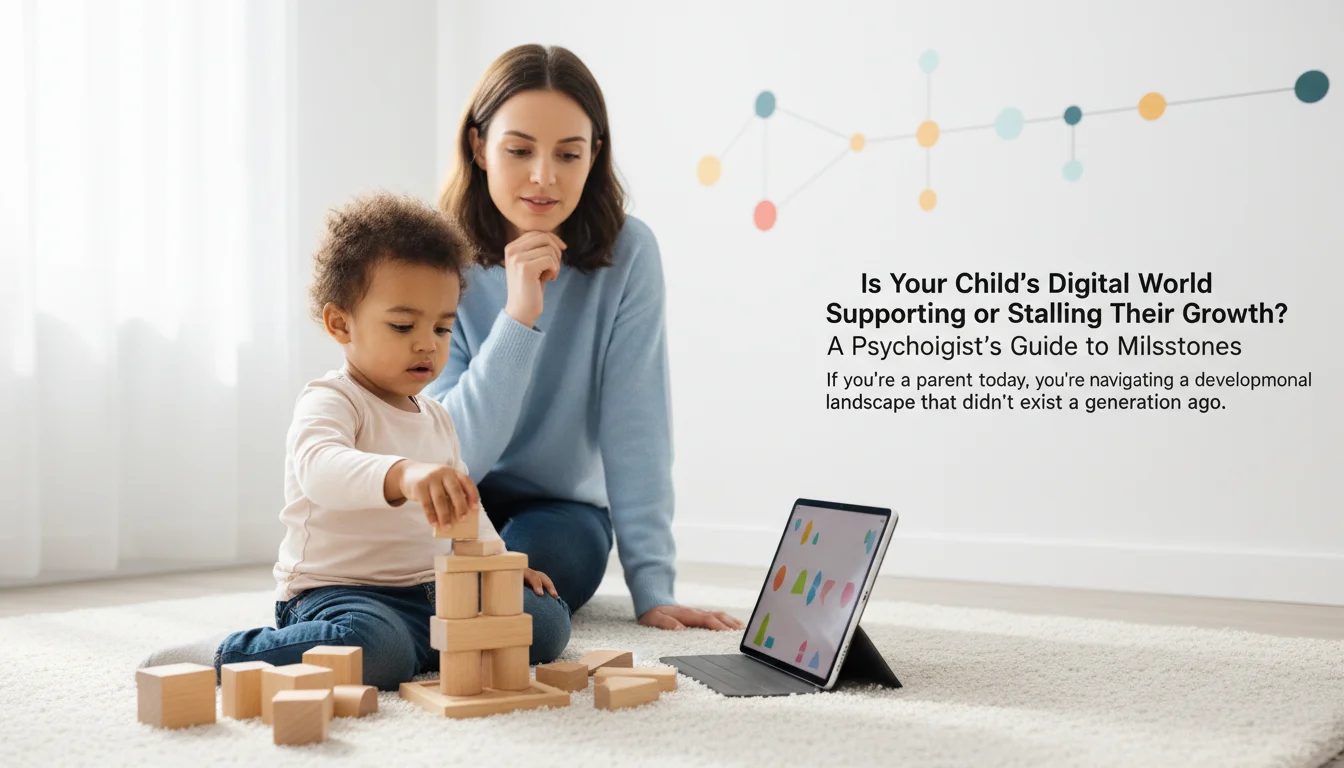
Is Your Child’s Digital World Supporting or Stalling Their Growth? A Psychologist’s Guide to Milestones
If you’re a parent today, you’re navigating a developmental landscape that didn’t exist a generation ago. The question isn’t just, “Is my child walking or talking on time?” It’s, “Is the tablet time helping their ABCs but hurting their ability to hold a crayon?” The anxiety is real, and I hear it daily in my practice. You’re not overreacting. You’re recognizing that development is now a complex dance between physical, cognitive, and digital realms.
My goal here is not to add to your guilt. Instead, I want to offer you a new lens—an Integrated Development Framework. We’ll move beyond the old charts and learn how to thoughtfully weave digital tools into the rich tapestry of physical play and real-world exploration that fuels healthy growth. This is about intentional integration, not panic-driven elimination.
Reimagining Milestones for the Digital Age
Traditional developmental milestones—rolling over, stacking blocks, imaginative play—remain the non-negotiable bedrock of healthy growth. They are the brain’s way of building itself, layer by layer, through sensory-motor experience. A child who struggles to cross the midline (reaching across their body) may later have difficulty with reading and writing. The pincer grasp developed while picking up Cheerios is the same fine motor skill needed for buttoning a shirt and, eventually, typing.
The digital world introduces a parallel set of experiences. Swiping, tapping, and navigating menus can develop certain types of visual-spatial reasoning and problem-solving. Educational apps can reinforce letter and number recognition. But here’s the critical psychological insight: digital skills are narrowcast, while physical play is broadcast. Building a block tower engages fine motor skills, spatial reasoning, cause-and-effect understanding, frustration tolerance, and potentially social negotiation if done with a sibling. Tapping a screen to make a virtual block tower fall primarily engages visual tracking and a simple cause-effect tap.
The modern parenting task is to become a Developmental Curator. Your role is to ensure the broad, foundational “broadcast” of physical milestones is firmly in place, then selectively introduce the “narrowcast” digital tools that can complement—not replace—them.
The Motor Skills & Screen Time Nexus: A Balancing Act
Let’s get practical. How does screen time directly interact with key motor milestones? The concern isn’t screens in a vacuum; it’s the opportunity cost. Time spent passively consuming is time not spent climbing, digging, scribbling, or building.
- Gross Motor (Large Movements): Crawling, walking, running, jumping. These skills require open space and full-body engagement. Excessive container time (in seats, swings, or with devices) can limit the practice needed for core strength and coordination. A toddler watching a show about animals isn’t developing the vestibular system like a toddler pretending to be that animal, galloping across the yard.
- Fine Motor (Small Movements): Grasping, stacking, drawing, using utensils. This is where the clash is most visible. Swiping is a simple, one-finger motion. The act of molding clay, threading beads, or using safety scissors involves a complex symphony of finger strength, bilateral coordination, and tactile feedback that a smooth glass screen cannot provide.
- Sensory Integration: Healthy development requires the brain to process input from all senses—touch, balance, body awareness, sound, sight. The digital world is overwhelmingly visual and auditory, offering a limited, curated sensory diet. A child needs to feel grass under their feet, the resistance of water when pouring it, and the proprioceptive feedback of pushing a heavy toy to fully wire their sensory systems.
To help you visualize this balance, I’ve created a framework called the Developmental Plate Method. Think of it like nutritional guidelines for your child’s growing brain and body.
| Age Range | Primary “Main Course” (Physical/Motor Focus) | “Digital Side Dish” (Complementary Digital Use) | Key Milestone to Protect & Observe |
|---|---|---|---|
| 0-2 years | Unstructured floor play, tummy time, exploring safe household objects, being read to from physical books. | Minimal to none. Occasional video calls with family are the primary exception. Screens do not support milestone achievement at this stage. | Object Permanence, Pincer Grasp, Cruising/Walking. |
| 2-5 years | Creative play (blocks, dolls, cars), outdoor running/climbing, art with varied materials (crayons, paint, chalk), helping with simple tasks (sorting laundry). | Short, co-viewed sessions (15-20 min) of high-quality content. Interactive apps that mimic real-world play (e.g., simple drawing, music makers) can be introduced sparingly, WITH a parent. | Complex Pretend Play, Drawing Shapes, Pedaling a Tricycle, Cooperative Play. |
| 5-8 years | Mastering physical skills (bike riding, sports fundamentals), extended creative projects (fort building, Lego sets), board games, reading physical books. | Educational tools for specific skill reinforcement (e.g., math games, typing tutors). Guided, project-based use (e.g., making a digital photo album of a nature walk). Time strictly limited to allow for primary activities. | Reading Fluency, Writing Legibly, Complex Rule-Based Games, Teamwork. |
From Safety to Savvy: Reframing Child Online Safety
When we hear “child online safety,” we often jump to content filters and stranger danger—and those are vital. But from a developmental perspective, safety is broader. It’s about psychological and cognitive safety. An age-inappropriate app isn’t just about scary images; it’s about interfaces that hijack attention with autoplay and rewards, training a child’s brain toward impulsivity. It’s about social platforms that introduce social comparison and curation anxiety before a child has formed a stable core identity.
Your strategy must evolve as your child does:
- The Guardian Phase (Ages 2-5): You are the gatekeeper. Use technical controls (parental controls on routers and devices) to create a walled garden of pre-approved content. Safety here is about preventing accidental exposure and ensuring content is slow-paced, non-commercial, and prosocial.
- The Guide Phase (Ages 6-10): You are the co-pilot. Begin to explain why you make the choices you do. “We don’t watch that because it’s designed to make you want to watch the next video without thinking. Let’s choose when we stop.” Start teaching basic digital literacy: “That’s an ad trying to sell you something.” This is the time to establish the Family Digital Contract, focusing on device-free zones (dinner table, bedrooms) and times (the hour before bed).
- The Mentor Phase (Ages 11+): You shift to consultant. The goal is internalized self-regulation. Discuss algorithms, echo chambers, and digital footprints. Talk about how curated social media feeds can impact self-esteem. Your role is to ask probing questions and help them develop their own critical thinking and healthy habits, knowing they will increasingly access the digital world independently.
The Weekly Connection Audit: Your Action Plan
Theory is useless without action. Here is a simple, 15-minute exercise I give to families. Do this once a week, perhaps on a Sunday evening.
Step 1: The Milestone Check-In. Briefly reflect. Not with anxiety, but curiosity. Did your child master a new physical skill this week? Ride a bike? Do a cartwheel? Write their name more clearly? Did they engage in deep, imaginative play? Jot down one “win.”
Step 2: The Digital Diet Review. Look at your device’s screen time reports (use them as a mirror, not a hammer). What was the balance between passive consumption (YouTube, Netflix) and active creation (coding, digital art, research for a project)? Did digital time crowd out time for the “main course” activities from our Plate Method?
Step 3: The One Shift. Based on your audit, make ONE small, achievable change for the coming week. It could be:
- “This week, all tablet time will happen only after 30 minutes of outdoor play.”
- “We will try one new ‘analog’ activity: baking together or a family board game night.”
- “I will turn off all autoplay features on our streaming apps to practice intentional stopping.”
This audit isn’t about perfection. It’s about purposeful awareness. It turns the overwhelming task of “managing tech” into a manageable, weekly conversation about values and growth.
FAQ: Your Top Developmental Milestone Questions, Answered
Q: My child’s school uses tablets heavily. Isn’t that undermining motor skills?
A: This is a common concern. The key is what happens at home. If school use is sedentary, advocate for movement breaks and hands-on projects. Then, consciously prioritize fine and gross motor activities after school. Be the counterbalance. Communicate with teachers about your holistic development approach.
Q: Are there any digital tools that can actually support motor development?
A: Yes, selectively. Look for apps that pair with physical action. For example, apps that guide yoga or dance routines, or coding kits that involve building a physical robot to then program. The best tools use the digital interface to prompt real-world movement and manipulation. The American Academy of Pediatrics offers resources on finding quality media.
Q: My teen only wants to be online with friends. Is this social development?
A: It’s a new form of socializing, but it’s incomplete. Online interaction lacks nonverbal cues, physical camaraderie, and the nuanced practice of navigating shared physical space. Validate that their friendships are real, but insist on a hybrid model. Encourage them to translate online connections into offline hangouts. The skill of the 21st century will be fluidly moving between digital and in-person connection.
Q: I’m worried about my own screen use modeling bad habits. Where do I start?
A: You’ve identified the most powerful lever for change. Start with your own “Connection Audit.” Model the behavior you want to see. Use device-free zones for yourself too. Say out loud, “I’m putting my phone away now so I can focus on this puzzle with you.” Your mindful integration is the most powerful lesson your child will receive.
Remember, development is not a race with a single finish line. It’s the gradual, sometimes messy, accumulation of thousands of experiences. Your role is to ensure those experiences are diverse—that the tactile, sweaty, frustrating, and joyful experiences of the physical world form the sturdy foundation upon which the digital world can be safely and productively built. By becoming a Developmental Curator, you’re not just tracking milestones; you’re actively building a whole, resilient human being.


https://shorturl.fm/gRpFZ
ikeepj